
...

Resource Library

VM Reports

AI in B2B Marketing Hype vs Reality

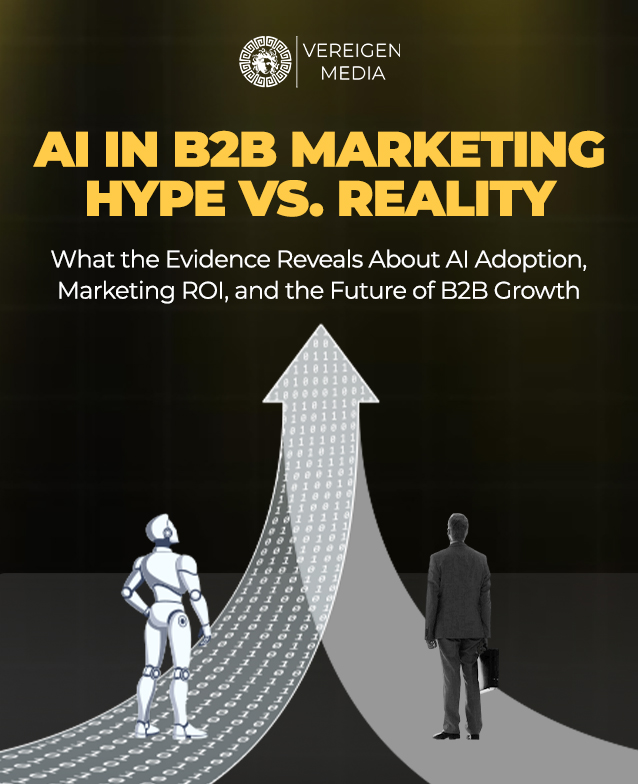
AI in B2B Marketing: Hype vs. Reality

Is AI adoption translating into measurable business value?
AI adoption is widespread across B2B marketing, but its impact on business performance remains uneven. This report examines the gap between AI implementation and measurable outcomes, revealing where AI delivers value, where expectations exceed the evidence, and what marketing leaders should prioritize in 2027.

Drawing on 22 core surveys, seven buyer studies, controlled experiments, financial disclosures, clickstream data, market analysis, and regulatory research, Vereigen Media explores the realities shaping AI-driven B2B marketing.

Key insights covered in this report:

  • AI adoption versus implementation maturity.
  • Productivity gains versus measurable marketing ROI.
  • AI investment, market growth, and customer spending.
  • AI-powered search and changing B2B buyer behavior.
  • Human validation, trust, and content credibility.
  • AI governance, compliance, and workforce readiness.
  • Strategic priorities for B2B marketing leaders in 2027.

Who Should Read This Report?
CMOs, B2B marketing executives, demand generation leaders, marketing operations professionals, revenue leaders, and business decision-makers looking to make informed AI investments.

Download the Report
Discover what the evidence reveals about AI in B2B marketing and prepare your organization for the next phase of marketing transformation.

Fill the details to download the report

The Answers To Your Questions

What is AI in B2B marketing, and how is it changing marketing strategies?

AI in B2B marketing refers to using artificial intelligence to support activities such as content creation, audience research, personalization, campaign optimization, predictive analytics, and customer engagement. It is changing how marketing teams operate, but its effectiveness depends on implementation maturity, workflow integration, and measurable business outcomes.

What are the biggest challenges of implementing AI in B2B marketing?

Key challenges include limited implementation maturity, difficulty measuring ROI, fragmented workflows, data readiness, regulatory compliance, and maintaining buyer trust. Organizations also need appropriate employee training and human oversight.

How is generative AI changing B2B marketing and content creation?

Generative AI is helping marketing teams accelerate content production, research, personalization, and other repetitive activities. However, organizations must maintain content accuracy, originality, transparency, and human editorial oversight to ensure credibility.

How is AI-powered search changing the B2B buyer journey?

AI-powered search is changing how B2B buyers discover information, research potential vendors, and evaluate solutions. As AI-generated summaries influence organic search visibility, businesses need credible, structured, and authoritative content that can serve both AI answer engines and human researchers.

Will AI replace human expertise in B2B marketing?

AI can automate and accelerate specific marketing tasks, but human expertise remains essential for strategic decision-making, content validation, relationship building, and understanding complex buyer requirements. The report highlights that 69% of surveyed B2B buyers prefer validating AI-generated insights with sales representatives.

What should B2B marketing leaders prioritize when adopting AI in 2027?

Marketing leaders should prioritize measurable outcomes, redesign key workflows, improve data readiness, strengthen AI governance, invest in employee capabilities, and develop content strategies for AI-powered search and human validation.

What are the major AI marketing trends B2B businesses should prepare for in 2027?

Important developments include outcome-based AI investments, greater emphasis on AI transparency, workflow automation, AI-powered buyer research, improved measurement frameworks, and content strategies that combine AI visibility with human credibility.

Why is human verification important in AI-driven B2B marketing?

Human verification helps improve information accuracy, establish credibility, and reduce the risk of misleading or unsubstantiated claims. As buyers increasingly use AI for research, businesses must ensure their content and marketing communications are accurate, trustworthy, and supported by credible expertise.

What are the AI trends B2B marketing leaders should watch in 2027?

Key trends include AI-powered buyer research, answer-engine visibility, workflow automation, outcome-based AI pricing, responsible AI governance, advanced personalization, and human-validated content. The report suggests that organizations capable of demonstrating measurable AI-driven improvements will be better positioned to compete.

What can B2B executives learn from the AI in B2B Marketing: Hype vs. Reality report?

The report helps executives understand where AI is delivering measurable improvements, where industry expectations exceed available evidence, and how AI is influencing B2B buyers and marketing operations. It also provides strategic recommendations, market insights, and a 90-day starting plan to help organizations prioritize AI investments and prepare for 2027.

You make also like

View all

AI in B2B Marketing Hype vs Reality

November 3, 2026

AI in B2B Marketing: Hype vs. Reality

Explore the 2026 AI in B2B Marketing research report to understand AI adoption, proven results, marketing ROI, buyer behavior, and
Inside the Modern Buying Committee

September 21, 2026

Inside The Modern Buying Committee

Explore how modern B2B buying committees make decisions, including stakeholder roles, committee size, buyer research, consensus, and purchase behavior.

apply here