 Skip to content

Knowing a company’s industry tells you who they are.
But knowing their technology stack tells you how they operate and what they need next.
In today’s B2B landscape, growth no longer stalls because of a lack of demand. It stalls because teams rely on the incomplete context and assumptions. Two companies can look identical on firmographic chart same industry, same size, same revenue yet only one becomes a viable customer.
The difference is not budget, it’s the technology alignment.
That’s because their technology differs completely from your offerings.
Modern B2B buying decisions revolve around integration, compatibility, security standards, and workflow efficiency. When your solution fits seamlessly into a buyer’s existing momentum environment momentum builds and the sales cycle accelerates.
If it doesn’t no amount of persuasion removes the friction.
This is where technographic data fundamentally changes the conversation by closing the gap and revealing the actual technology environments inside targeted companies and how go-to-market teams operate.
In this blog, we’ll explore how technographic data works, why it’s essential, why it matters for modern B2B go-to-market teams, and how Vereigen Media’s first-party, privacy-compliant approaches turn technographics into measurable outcomes.
Why B2B Teams Struggle Without Technology Context
Most go-to-market teams still segment audiences using three traditional lenses:
- Firmographics (industry, revenue, company size)
- Demographics (job titles, seniority, function)
- Behavioral signals (content engagement, intent activity)
This helps you get clarity on who the real buyer is and what they’re reading but not revealing how they operate.
This missing layer leads to common breakdown:
- Salesforce integrations pitched to HubSpot native team customers
- Security vendors selling compliance tools to companies already standardized elsewhere
- Data platforms targeting organizations without the infrastructure to deploy them
- Marketing messaging mismatched with the buyer’s maturity level
Buyers notice instantly. Relevance becomes the new professionalism in B2B communication.
What Is Technographic Data in B2B Marketing?
Technographic data is a specialized form of market segmentation that is used to run its business operation. This specialized form helps you reveal the hardware, software, applications, and IT infrastructure a company uses with usage patterns and adoption trends.
Unlike firmographic data (company, size, revenue, location) or demographic data (job titles, roles), technographic data reveals different: What technology does the company rely on?
This covers:
- Marketing automation platforms (HubSpot, Marketo, Pardot)
- CRM systems Salesforce, Microsoft Dynamics, Zoho)
- e-commerce solutions (Shopify, WooCommerce)
- Analytic tools (Google Analytics, Adobe Analytics)
- Collaboration software (Slack, Microsoft)
- Content management system-CMS (WordPress, Drupal)
- Cloud infrastructure (AWS, Azure, Google Cloud)
This data helps B2B companies to transform how they identify prospects by revealing operational reality. By this, you’re no longer marketing a job title, but you’re speaking to an ecosystem.
What Are Technographics, and Why Should You Care?
Technographics are the data points that help the GTM team understand the detailed technology stack, software, hardware, and applications they use. It also helps to understand how technology decisions shape the buying behavior and understand a prospect’s tech environment.
It also helps you gain the actionable insights to:
- Understand their priorities
- Identify compatibility
- Spot timing opportunities
- Reduce wasted outreach
This drives you to move beyond the traditional firmographics and understand how a prospect operates, what they are likely to purchase next, and when they are ready for a sales conversation.
Here, you get a detailed insights into competitor’s behavior through precision targeting and can identify sales opportunities, sales conversations, reduce churn rate, and prioritize lead for measurable business outcome.
How B2B Teams Use Technographic Data Across GTM
The real power of technographic data emerges when the data is applied across your entire go-to-market motion.
- Sales Teams Prioritize High-Value Prospects: Instead of cold calling they build targeted account lists
- Marketing Teams Personalize Campaigns: This helps them to speak directly to prospect’s current technology environment, which results in increase in click-through rates, content engagement, and conversion.
- Account-Based Marketing Gets Sharper: Helps in targeting and delivering the hyper-relevant content that addresses their exact use cases.
- Product Teams Inform Development Priorities: Build compatible features and eliminate friction in the buyer journey.
- Competitive Intelligence Improves: Which competitors have market traction in your target accounts?
The Benefits of Technographic Segmentation
When markets are segmented by technology stack, measurable advantages emerge:
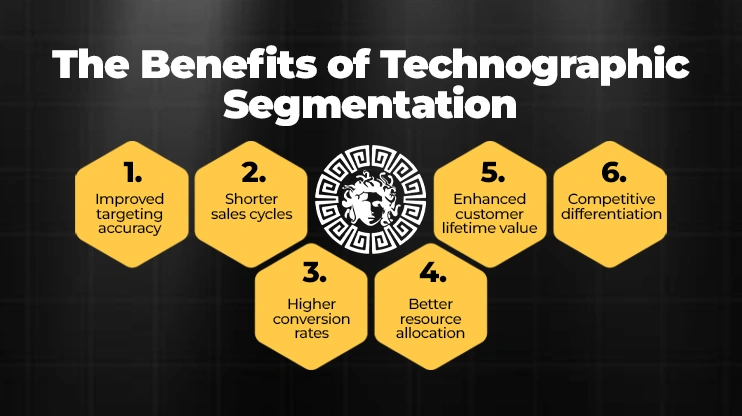
- Improved targeting accuracy: You reach prospects most likely to need and adopt your solution
- Shorter sales cycles: Relevant messaging and compatibility reduce evaluation time
- Higher conversion rates: You’re solving problems prospects already recognize
- Better resource allocation: Sales and marketing focus energy on qualified opportunities
- Enhanced customer lifetime value: Better-fit customers stay longer and expand usage
- Competitive differentiation: While competitors spray generic messages, you deliver precise value propositions
These benefits compound over time. As you refine your technographic segmentation, your understanding of ideal customer profiles deepens, creating a virtuous cycle of improving targeting and results.
Quick Read: What Is a Go-To-Market Model and Why Every B2B Business Needs One
How to Collect Technographic Data Responsibly
Not all technographic data is created equally, but accuracy, verification, and compliance matters. This comes with several collecting methods:
- Direct surveys and outreach
- Third-party data providers
- Website and code analysis tools
- Sales intelligence platform
- Manual research for high value accounts
At Vereigen Media, technographic data is treated as first-party intelligence, verified through real engagement rather than automated assumptions.
Leads. Done Right.
What Makes Technographic Data Actionable
Many teams collect technographic data but fail to operationalize them and drive outcome. Actionability comes from integration into workflow decisions:
Marketing
- Dynamic messaging by stack
- Platform-specific landing pages
- Persona-plus-technology nurture journeys
Sales
- Call talk-tracks aligned to infrastructure
- Faster qualification
- Higher meeting acceptance
RevOps
- ICP scoring models
- Territory prioritization
- Expansion forecasting
Technographics become powerful only when they guide decisions, not dashboards.
The Strategic Advantage: Relevance at Scale
Modern buyers don’t reward volume, they reward preparedness.
Teams that operationalize technographic insight consistently experience:
- Higher conversion rates
- Lower acquisition costs
- Shorter sales cycles
- Better expansion revenue
Because conversations begin where buyers already are, not where vendors assume they are.
Organizations adopting first-party validated technographic targeting move from broad outreach to operational alignment.
Turning Technology Insight Into Revenue Impact
Sustainable B2B growth mainly depends on how well you understand the buyer’s operating environment even before having the first conversation. Technographic data provides you a clarity by giving you a clear insights and view on how buyers operate, decide, and invest.
When these insights and data are used responsibly and paired with verified engagement and first-party intelligence, technographics transform outreach into alignment and targeting into trust.
If your team is ready to move beyond surface-level segmentation and into data-driven relevance, the next step is simple.
Book a strategy session with Vereigen Media today to activate first-party technographic intelligence across your pipeline.
Leads. Done Right.
Technographic data is a collective segmented data of a company that reveals the overall technology stack information. It’s crucial for identifying high value prospects, which helps in improving lead qualification and hyper-personalizing campaigns.
B2B technographic data improves lead quality by revealing the technology stack data of a company, allowing companies to target, prioritize, and personalize outreach with high precision.
Technographic segmentation in demand generation involves dividing, targeting, and prioritizing B2B prospects and grouping the companies by technology stack such as software, hardware, applications, and IT infrastructure.
Yes. Combining verified engagement with technology context shows both interest and operational fit, making targeting significantly more accurate.
Vereigen Media, a U.S.-based demand generation company that uses in-house first-party data to pair technographic insights with human-verified engagement, ensuring outreach reaches stakeholders actively.
Written By –
