 Skip to content

Account-based marketing (ABM) has never been more powerful or more demanding.
Across global B2B organizations, marketing leaders are under real pressure: larger target account lists, tighter budgets, and increasingly complex buying committees. Today’s decisions are made by almost 6-10 stakeholders, each consuming the valuable content across different channels before engaging with sales.
The shift has changed the approach to how ABM must operate.
The old playbook of broad outreach and hoping the content lands to the right person and they respond to it doesn’t cut it anymore.
This is where programmatic ABM comes in.
The convergence of programmatic advertising precision and ABM strategy is fundamentally changing how revenue teams engage.
The convergence of programmatic advertising precision and ABM strategy is fundamentally changing how revenue teams engage with their most valuable accounts across multiple channels, building smarter engagement engines. From display to native advertising strategy executions, the shift is not technological, it represents a strategic transformation in how marketing teams are transforming and expanding with the brands influencing account engagement, buying signals, and measurable influence.
In many ways, the future of ABM is inseparable from the evolution of programmatic advertising, where automation, intent data, and strategic orchestration come together to create a more scalable and intelligent engagement model.
In this blog, we’ll explore more about how programmatic advertising is transforming ABM strategies and what forward thinking B2B organizations must do today to remain competitive in the next era of demand generation.
Why Traditional ABM Strategies Struggle to Scale
Account-based marketing (ABM) has long been valued for prioritizing quality over quantity.
However, traditional ABM approaches often struggle to scale effectively.
Many early programs relied on manual personalization, a generic account list, and siloed campaign-execution that cannot handle increased complexity. While effective for small account sets, these models quickly become difficult to sustain as organizations expand their markets.
Too many B2B marketing leaders encounter several operational challenges when scaling ABM initiatives:
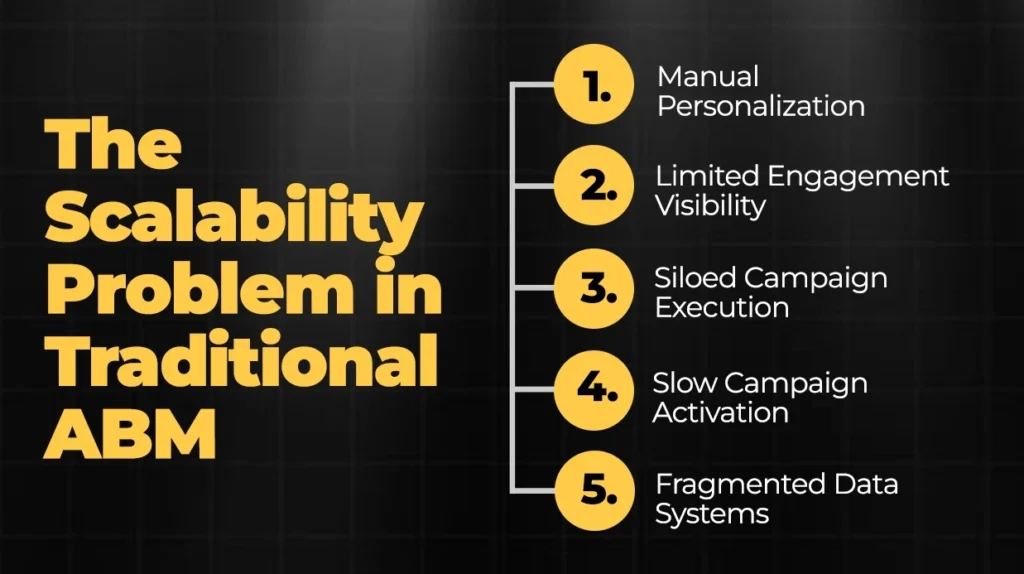
- Limited visibility into account-level engagement signals
- Difficulty reaching multiple stakeholders within buying committees
- Slow campaign activation across digital channels
- Inefficient media spend caused by manual targeting
- Fragmented data across CRM, marketing automation, and advertising platforms.
For executive leaders responsible for pipeline performance, this challenge creates a critical question:
How can organizations maintain ABM precision while increasing scale and efficiency?
Programmatic advertising is increasingly becoming the answer.
What Is Programmatic ABM, and Why Does It Matter Right Now?
At its core, programmatic ABM strategic targeting of account-based marketing with the automation and scale of programmatic advertising.
Rather than hyper-targeting broader audiences based on general demographics, job titles, or industries, but actual established brands on your priority list. Programmatic ABM enables marketers to deliver personalized, genuine content directly in front of the right decision-maker, on the right channel, at the right moment in their buying journey.
For executive leaders managing demand generation budgets, the value is clear: reduced wasted spend and increased targeting precision.
Traditional digital advertising burns your marketing budget, reaching people who will never buy from you. But, programmatic ABM flips that equation, by ensuring that every impression is delivered to accounts that actually matter to your business.
According to Salesforce research, 79% of B2B marketers report higher ROI from ABM, than any other marketing effort.
When programmatic advertising is layered on top of your ABM the impact becomes even more greater, enabling marketing teams to scale personalization while maintaining strategic account focus.
How Programmatic Advertising Trends Are Changing B2B Outreach
The programmatic advertising trends are reshaping B2B outreach by focusing on structural cause. Here’s what’s actually moving the needle:
Intent Data Integration Is No Longer Optional
Modern programmatic advertising trends like intent data integration have become crucial than ever. Relying solely on firmographic data, such as company size and industry is outdated. So modern marketers are relying on actively researching customers and are layering their intent data for measurable impact.
This is what makes you to reach the genuine customer who is actively researching for your solution. A prospect’s behavioral signals, such as prospect visiting competitor review pages, downloading industry reports, or attending digital events triggers a coordinated ad sequence across channels.
This is the real difference between presence and relevance caused by intent data integration.
Cross-Channel Orchestration Across Programmatic Channels
Traditional ad campaigns, which were running in silos are gone.
Now the ABM syn actively with multiple channels, display, connected TV, native, and even beyond the desktop screens. This cross-channel orchestration builds recall and trust faster than any single touchpoint could alone.
AI-Driven Personalization at Account Level
AI is transforming B2B from broad segment targeting to hyper-personalization at account level, where 1:1 engagement is seen to scale. Here, the learning models are allowing marketers to dynamically adjust creative, content, and offer personalized messaging that align and educate the prospect. With AI-driven personalization, an account showing strong purchase intent sees content that drives a conversation towards a measurable impact.
This personalization approach isn’t just an approach, it’s a revenue lever.
How Programmatic Advertising Is Transforming Account-Based Marketing (ABM)
Let’s be direct, about how programmatic advertising is transforming account-based marketing, as this reshaping approach goes beyond automation, i.e., from manual, narrow outreach to automated, high-precision targeting at scale.

Below are the fundamental changes that engage high-value accounts:
1. Account-Level Targeting at Scale
Instead of targeting broad demographics, programmatic technology allows marketers to target and reach stakeholders of a specific company across multiple websites, platforms, and digital environments by using IP intelligence, firmograhic data, and intent signals.
2. Real-Time Data Activation
Traditional campaigns often depend on historical data and generic targeting across a broad contact list.
Programmatic advertising continuously analyzes behavioral signals by relying on real-time data activation, such as:
• Content consumption patterns
• Industry-specific research activity
• Intent signals from buying groups
By this, they personalize ad creatives by adjusting campaigns in real-time to reflect the industry, company, and buying stage of a targeting account enhancing relevance.
3. Multi-Channel Account Engagement
One of the most important programmatic advertising trends is the expansion of its advertising strategy across multiple digital channels.
Modern ABM strategies now integrate:
- Programmatic advertising to enhance the campaign strategy
- Video and CTV
- Native ad placements
- Social media amplification
4. Improved Efficiency and ROI
Programmatic ads when integrated in the ABM campaigns results in reduced wasted spend. It leads to higher engagement and lower customer acquisition costs (CAC).
These programmatic channels allow marketers to maintain consistent visibility with decision-makers across the platforms they use daily.
The result is greater brand familiarity and stronger influence throughout the buying cycle.
What Does the Future of ABM Actually Look Like?
The future of ABM isn’t a single technology, it’s an operating model. Today it’s been shifting from a manual, campaign based to an AI-driven, fully automated, data centric ecosystem.
Here’s what leading global B2B companies are already building toward:
1. Unified Data Layers Connecting CRM, MAP, and Programmatic
The companies winning at ABM are the ones that have connected their CRM, MAP, and programmatic data directly into their strategic execution layer. Executives account status, deal stage, engagement score, all of it informs how and when ads are served. When a deal moves to negotiation, programmatic automatically suppresses acquisition ads and shifts to retention and expansion messaging. That’s not a future state, it’s happening now for teams willing to invest in the infrastructure.
2. AI-Driven Precision and Contact-Level Targeting
AI and intent data are the central and most crucial data for the future of ABM, that help marketers move from vanity metrics to measure actual revenue impact. Whereas AI tools and human verification are used to analyze vast datasets to uncover buying signals and predict the next actions.
With contact-level targeting and AI-driven precision marketers are believed to be moving from account-level to contact-level targeting the individual personas within an account. This allows for more precise, relevant, and effective engagement.
3. Content Syndication as a Programmatic Channel
Content syndication, what Vereigen Media calls Verified Content Engagement, is evolving into a precision programmatic channel in its own right. Rather than blasting content to massive opt-in lists and hoping for quality, next-generation syndication matches your content to verified active researchers within your target account universe. The result is inbound intent from your exact ICP, not noise from irrelevant job functions or geographies.
4. Display and Programmatic Ads Working as One Engine
VM Engage, Vereigen Media’s display and programmatic ad solution, reflects exactly where the market is heading: tight account targeting, real-time intent activation, and closed-loop attribution. Rather than treating display as an awareness play and programmatic as a separate budget line, the future of ABM integrates them into a single, continuously optimized engine that adapts to account behavior.
5. Full-Funnel Integration
ABM when integrated into full-funnel of customer success, with a focus on retention, upselling, and expansion within existing accounts results in measurable business impact.
Why Vereigen Media Approaches ABM Programmatic Differently
Most vendors in this space offer advanced AI tools.
As ABM strategies become more data-driven and programmatic, organizations increasingly require a partner capable of delivering verified engagement rather than inflated lead volumes.
This is where Vereigen Media’s approach differs.
Vereigen Media, a U.S.-based leading demand generation company offers genuine outcomes. While working with B2B companies across IT, SaaS, Finance, HR, Marketing and other industry sectors worldwide, Vereigen Media’s approach is built on one core principle: verified engagement, not inflated metrics.
Through Verified Content Engagement an advanced content syndication solution targets the accounts and are served with the valuable educational content that matches their active research behavior, and engagement here is verified, not assumed. Through VM Engage, display and programmatic ads are activated against the same account universe, creating coordinated surround-sound coverage across the full buying committee.
Every lead passed by Vereigen Media to your sales team has been verified for account fit, contact accuracy, and genuine content engagement.
Programmatic ABM Is a Revenue Strategy, Not Just an Advertising Tactic
The organizations that treat ABM and programmatic advertising as separate tactical initiatives will get tactical results. However, companies that treat ABM programmatic as a convergence in their campaign, their data, content, sales alignment, and programmatic channels get build a compounding advantage over time.
The future of ABM belongs to teams that are willing to invest in:
- Clean and unified data infrastructure
- Clearly aligned ICP
- High-value educational content
- Genuine engagement measurement.
The technology to enable this information already exists.
The real question is whether your organization is structured to take advantage of it.
You don’t have to figure this out alone.
Ready to Make Your ABM Strategy Smarter?
Your competitors are already ahead of you they are already using ABM programmatic strategy to reach the right accounts at the right time for measurable revenue impact. Don’t get left behind.
Book your free strategy session with Vereigen Media today.
Leads. Done Right.
Frequently Asked Questions on the Future of ABM & Programmatic ABM
ABM programmatic combines account-based marketing strategy with automated programmatic advertising to target specific companies and decision makers to reach with personalized messaging across multiple digital channels more efficiently. Instead of targeting broad audiences, use programmatic technology to serve ads specifically with personalization to decision-makers at those companies across digital channels, native CTV, and more based on firmographic data, IP targeting, and intent signals.
The most effective programmatic channels for B2B ABM in the current environment are display advertising for broad account-level awareness, content syndication for mid-funnel intent capture, connected TV for executive-level reach, and native advertising for high-engagement contextual placements. The key is orchestrating these channels together rather than running them as independent campaigns.
The future of programmatic advertising in B2B looks like to be shifted from manual buying to agentic AI buying, using first-party data and intent-driven targeting by reaching specific, high-value decision-makers with precision.
Vereigen Media, a U.S.-based demand generation company supports ABM programs and programmatic advertising strategies through Verified Content Engagement (VCE) a content syndication strategy and VM Engage a display and programmatic advertising solution helping organizations reach real decision makers where they are present to generate meaningful engagement that drives pipeline growth.
Written By –
