 Skip to content


Modern B2B growth isn’t driven by volume, nor a particular team effort. It’s driven by alignment, starting the conversations and building the relationships while nurturing them.
Understanding the distinction between B2B lead generation and lead nurturing is essential for many B2B teams. As both processes are interconnected, they serve different purposes and require a unique approach to maximize the sales pipeline.
Many organizations pour budgets into attracting and generating new leads, and they struggle to convert them into pipeline growth. Revenue leaders have now realized that attracting potential buyers is just half of the equation. What truly separates high-performing potential leads is how well those leads are nurtured and informed.
Yet many organizations still treat lead generation vs. lead nurturing as competing priorities. Especially in long buying cycles, success isn’t about choosing one over the other. It’s about building a coordinated system that moves prospects from awareness to trust to decision.
In this blog, we’ll explore the differences between lead generation and lead nurturing strategy, explains how they work together, and how to build a system where both works together and drive predictable pipeline impact.
What Is Lead Generation in B2B?
Lead generation in B2B is the strategic process of attracting and capturing the interest of new potential buyers for a company’s products or services to drive pipeline growth. It mainly focuses on the prospects who show the initial engagement or the interest, but they are not yet ready to purchase.
The goal here isn’t immediate conversion, it’s all about awareness, discovery, and getting permission to continue further for the conversation, while identifying B2B leads who match the ideal profiles and bring them into the ecosystem.
Here, common lead generation tactics include:
- Content marketing
- Event and Webinar registration
- Targeted advertising
- Account-based outreach
- First-party data capture
- Verified audience engagement
At this stage, the prospects are discovering the brands, evaluating problems, and exploring possible solutions. At the beginning of the sales funnel, the leads are yet to learn and understand the solutions and services, by creating a steady stream of qualified B2B leads.
But here’s what most of the teams go wrong, by stopping and celebrating the acquisition metrics, impressions, clicks, downloads, without building a system that matters.
Generating interest without structured follow-up and nurturing is like filling a bucket with holes, which results in the leaking of prospects before revenue happens.
According to Invespcro, 80% of new leads never convert into the purchase cycle.
This is where lead nurturing comes in picture, keeping the relationship alive.
What Is Lead Nurturing?
Lead nurturing is the process of developing trust and a relationship with prospects over time through relevant, human-centered interaction.
It acknowledges the fundamental truth of every modern B2B buying:
Buyers don’t convert instantly, they are rarely ready to purchase at first instant. They evaluate, compare, research, and discuss internally while bridging the gap between curiosity and commitment.
A strong B2B lead nurturing strategy ensures that you are educated, informed, and feel valued throughout the journey while ensuring your brand stays top of the buyer’s mind.
Lead nurturing strategy includes:
- Personalized communication during follow-ups
- Providing education content asset
- Thought leadership content aligning with the buyer’s journey
- Buyer’s stage messaging that keeps your brand top-of-mind.
- Human-verified outreach
B2B lead nurturing doesn’t push the content for immediate conversion, they focus on nurturing and guiding the prospects for measurable outcomes, with multi-touch engagement across channels.
Companies or agencies that treat the nurturing services as all about building relationships with those leads over time to see improvement in the performance, by aligning the content with intent signals. Companies that align with lead nurturing see compounding ROI.
Lead Generation vs Lead Nurturing: The Core Differences
While both strategies support the pipeline growth, their goals and processes differ. Understanding such distinctions helps you get clarification on how resources should be allocated.
“Lead conversation leads in starting the conversations.
Lead nurturing leads to deepen the relationships.”
Here’s a practical breakdown:
| Aspect | Lead Generation | Lead Nurturing |
| Objective | Reach | Build relationship |
| Buyer Journey | Early stage | Mid to late |
| Messaging style | Broad, educational | Personalized and intent driven |
| Primary Goal | Capture interest | Build trust & readiness |
| Focus | Quantity & reach | Quality & engagement |
| Timeline | Short-term | Long-term |
| Success Metric | Leads captured | Leads converted |
Understanding lead generation and lead nurturing helps B2B teams stop treating leads as transactions.
High-performing B2B teams don’t treat these as separate dashboards, as both are essential and neither replaces the other. They measure so well that every new lead immediately enters a structured nurturing path, lifting the revenue.
Why B2B Teams Fail When They Separate the Two
It’s not about which matters most, it’s all about how they work together.
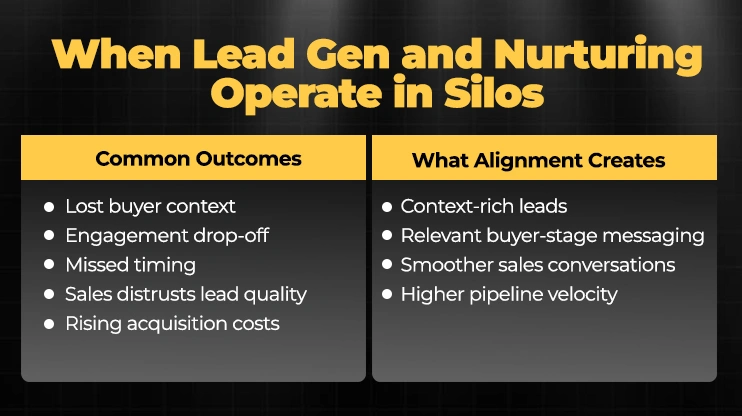
When lead generation and nurturing start to operate in silos, friction appears, resulting in:
- Lost context
- Engagement drop
- Missed timing
- Marketing hands off cold leads.
- Sales distrusts pipeline quality.
- Cost per acquisition rises
Alignment creates continuity, where a unified strategy ensures:
- Leads enter with context
- Personalized message according to buyer intent
- Engagement remains relevant and human
- Natural sales conversations
This is where honor’s lead generation and nurturing strategies become critical, respecting buyer’s timelines, validating real engagement, and prioritizing human connection over generic and automation.
With this, the buyer experiences continuity instead of friction.
Quick Read: 5 Expert-Backed Ways to Improve B2B Lead Conversion Rates
What a Modern Lead Nurturing Strategy Looks Like
Today, modern lead nurturing strategy combines data intelligence with verified human engagement. Here, raw lead volume is no longer a growth strategy, the modern B2B lead nurturing strategies focus on:
- Behavioral personalization
Content adapts based on engagement patterns, not static lists.
- Time-based engagement signals
Time spent on the content asset reveals intent more accurately than clicks alone.
- Verified audience interaction
Real human validation ensures marketing reaches decision-makers without wasting time, budget, and resources.
- Cross-channel Engagement
Email, content, display, and sales outreach work as one experience.
- First-party data feedback loops
First-party data insights continuously improve targeting and messaging.
This is where organizations gain a competitive edge, when teams invest in real engagement instead of vanity metrics.
Nurturing becomes a revenue engine.
How Lead Generation Feeds Lead Nurturing
B2B buying behavior shift reflects a deeper change in how modern buying decisions are made.
Lead generation passes the baton. Lead nurturing runs the distance for measurable outcomes.
When both the strategies are aligned:
- Messaging remains consistent
- Audience context is preserved
- Trust compounds over time
- Sales conversations become warmer
- Pipeline predictability increases
Without this alignment, teams chase numbers instead of building momentum.
The strongest b2b lead nurturing programs are designed before acquisition begins, not after leads arrive.
How Vereigen Media Bridges Lead Generation and Nurturing
Many organizations attempt to manage both strategies in one system internally, but struggle with scale, verification, and continuity.
They need a system that overcomes these struggles and connects awareness to trust. That’s where Vereigen Media, a leading expert in demand generation strategies provides a measurable advantage by combining:
- Human-verified B2B leads
- First-party data intelligence
- Time-based engagement tracking
- Zero outsourcing
Vereigen Media ensures that every lead entering your funnel is real, relevant, and ready to be nurtured meaningfully. It creates verified opportunities that are actively guided toward conversion.
This approach doesn’t fill the pipeline, it strengthens them. Because nurturing works best when the foundation is verified, the pipeline is filled with better leads that progress faster.
Final Takeaway: It’s Not Either/Or, It’s Both
Lead generation vs. lead nurturing is not a topic of debate or choosing a winner. It’s all about a partnership and recognizing that modern B2B growth depends on integration.
One attracts attention, the other converts attention into confidence.
Whereas together they build sustainable B2B growth.
Teams that master in balancing both strategies for modern B2B growth, don’t chase leads. They cultivate relationships that sustain long-term revenue.
If you want a strategy that connects the full journey, from first touch to sales-ready, there’s a smarter way to build it.
Book your free strategy session with Vereigen Media today and learn how we help you transform your funnel into a revenue engine.
Growth isn’t about filling your pipeline with leads. It’s about creating momentum that compounds ROI.
Leads. Done Right.
Frequently Asked Questions on Lead Generation vs. Lead Nurturing
The biggest difference between lead generation vs. lead nurturing is: Lead generation creates new opportunities, interest, while attracting and capturing the prospects. Lead nurturing builds relationships and trust over time while helping prospects move toward a sales-ready decision.
A company should hire or invest in lead nurturing services or an agency when they are generating leads but struggling with conversion, meeting quality, and pipeline velocity turning leads into paying customers.
Yes, B2B companies need both lead generation and lead nurturing strategies to build a sustainable profitable pipeline that convert interest into revenue.
Yes, a specialized lead nurturing agency such as Vereigen Media helps you improve conversion rates by improving quality, timing, and sales readiness.
Vereigen Media, a B2B demand generation company uses human-verified engagement, first-party data, and intent-based content strategies to support smarter nurturing.
Written By –
