 Skip to content


In modern B2B organizations, revenue challenges rarely stem from a lack of opportunity. More often the real obstacle is misalignment across go-to-market functions, strategy, marketing, sales, and revenue operations. When these teams operate independently, even the most promising organizations demand generation initiatives fails to translate into measurable revenue outcomes.
When these B2B organizational teams invest heavily in campaigns lead generation programs and sales outreach. Pipeline growth stalls because execution across the go-to-market team lacks coordination
In reality even the most sophisticated best GTM strategy consulting frameworks fail without the right operational structure behind them. High-performing organizations build integrate GTM teams that combine data, demand generation, sales execution, and revenue operations into a unified revenue engine that moves buyers through the funnel with precision.
For B2B leaders, the challenge today isn’t just about understanding what a GTM is, it’s building GTM teams that can scale growth while adapting to modern buyer behavior.
In this blog, we’ll explore how to structure a go-to-market team that turns strategy into measurable revenue, and why execution is where most organizations either win or stall.
What Is a Go-To-Market (GTM) Team and Why It Drives Predictable B2B Revenue?
A go-to-market (GTM) team is a cross-functional group of executives responsible for bringing a products or services in the new market, generating demand, and converting buyer interest into revenue.
The defining difference between average GTM and high-performing revenue organizations is Alignment.
High-performing teams align and operate around a shared objective: building predictable revenue growth.
In modern B2B organizations, GTM teams typically include leaders across:
- Marketing
- Demand Generation
- Sales
- Customer Success
- Revenue Operations
- Sales Development
When these roles and teams operate independently in-silos revenue becomes unpredictable.
Operating as an integrated GTM team, organizations gain:
- Clear buyer journey visibility
- Faster revenue cycles
- Higher deal conversion rates
- Consistent pipeline generation
According to Forrester, companies grow 19% faster when highly aligned.
Why Many GTM Teams Fail to Deliver Predictable Revenue
Most of the organizations treat go-to-market execution as a set of disconnected, tactical activities rather than a unified system. Investing heavily to run marketing campaigns, sales pursue opportunities, and operations manages systems.
But without alignment across these functions, the organization struggles to create consistent pipeline generation and predictable revenue forecasting.
The misaligned GTM execution results in:
- Weak demand intelligence
- Fragmented data and buyer insights
- Misaligned marketing and sales performance metrics
- Disconnected technology stacks
- Poor lead validation and pipeline qualification
Over time, these structural issues lead to wasted sales effort and stalled deals, so it’s necessary to solve these structural problems first.
The Core Roles Every High-Performing B2B GTM Team Needs
Before you can build a GTM team that scales, you need to get the structure right. The specific titles may vary by company size, but the functions are non-negotiable.
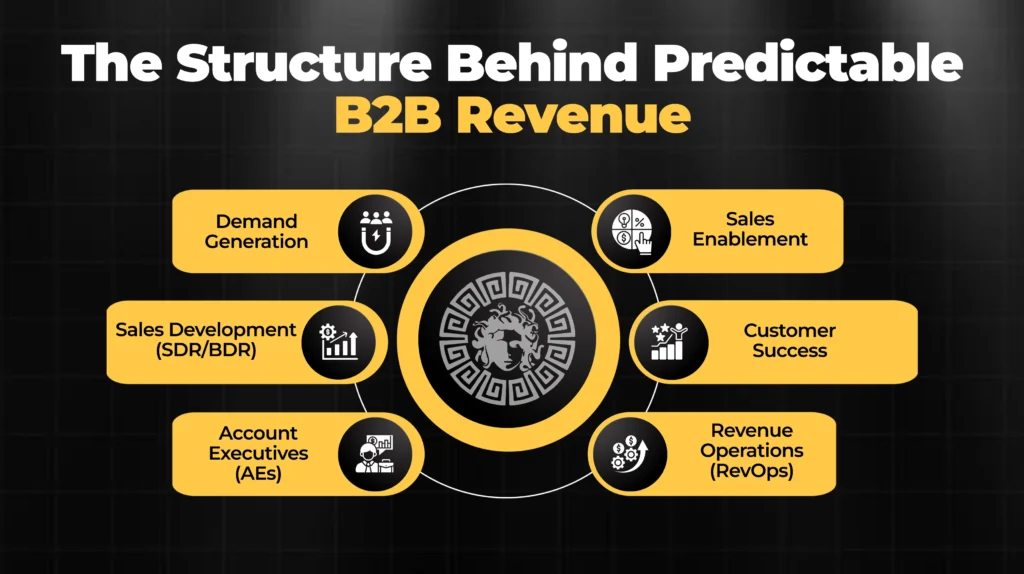
- Demand Generation: Responsible for top-of-funnel pipeline creation and audience engagement. This includes content syndication, programmatic advertising, paid media strategy, and account-based marketing (ABM). These programs help you identify prospects actively researching solutions and signals you for predictable revenue.
- Sales Development (SDR/BDR): Sales development representatives (SDRs) is the bridge between marketing and sales conversations that help you for measurable business impact. SDRs qualify inbound leads and execute outbound sequences against target accounts. They are your first line of human engagement and focus on qualifying engaged prospects, initiating discovery conversations, identifying buying committee, and validating sales opportunities.
- Account Executives (AEs): Own the full sales cycle from discovery to close. AEs should be focused on revenue conversion, not prospecting. When SDRs and demand gen are doing their jobs, AEs can focus on what they do best.
- Sales Enablement: Equips the sales team with the content, tools, training, and data they need to have better conversations. Without enablement, even great AEs lose deals they should win.
- Customer Success: Drives retention and expansion revenue. In SaaS and subscription-based businesses, customer success is often the highest-ROI function on the GTM team.
- Revenue Operations (RevOps): This acts as a connective tissue or a layer of gtm execution. RevOps help you manages CRM data integrity, pipeline forecasting, and attribution models across every GTM function so leadership can see what’s working and what’s not by scaling effectively.
How To Align Marketing and Sales Around Shared GTM Goals?
This is where most organizations struggle. Marketing measures MQLs. Sales measures closed-won deals. And the two teams spend more time debating lead quality than actually driving revenue together.
The fix isn’t a new CRM. It’s a shared revenue framework.
Start by agreeing on what a qualified lead actually looks like. Define your Ideal Customer Profile (ICP) with input from both sales and marketing. Then build your funnel stages, from first touch to closed deal, with clear hand-off criteria at each stage.
Shared metrics matter too. Consider aligning both teams around:
- Pipeline created (not just leads generated)
- Pipeline velocity (how fast deals move through stages)
- Win rate by segment or channel
- Revenue influenced by marketing
When both teams are measured by the same outcomes, collaboration becomes natural. The finger-pointing stops.
Quick Read: What Is a Go-To-Market Model and Why Every B2B Business Needs One
Why Go-To-Market Strategy Consulting Can Accelerate Your GTM Build
Building a GTM team internally takes time. And many organizations, especially those scaling from mid-market to enterprise, don’t have the luxury of a two-year build cycle.
This is where go-to-market strategy consulting partners add real value. A strong GTM partner brings external perspective, proven frameworks, and the ability to identify gaps in your current structure faster than an internal team can.
At Vereigen Media, the approach to GTM support is grounded in first-party data, audience intelligence, and account-based precision. With a database of over 110 million continuously validated contacts, Vereigen Media helps B2B organizations identify and engage their most relevant buyer segments, across IT, SaaS, Finance, HR, and beyond.
Whether you need Smart ABM to target high-value accounts, demand generation programs to build pipeline, or Digital Event Registration to drive qualified attendance, the goal is always the same: Leads. Done Right.
The Biggest Mistakes B2B Teams Make When Building GTM Functions
Even well-funded companies get this wrong. Watch out for these common GTM pitfalls:

- Building for headcount, not outcomes. Hiring more SDRs doesn’t fix a broken ICP or a weak value proposition.
- Treating ABM as a campaign, not a strategy. Account-based marketing only works when it’s embedded into your entire GTM motion, not bolted on as a Q4 tactic.
- Ignoring the middle of the funnel. Most GTM teams over-invest at the top and bottom. The middle, nurture, enablement, multi-stakeholder engagement, is where deals actually get won or lost.
- Misaligned tech stacks. When your CRM, MAP, and intent data aren’t connected, your team makes decisions based on incomplete information.
- No feedback loop between sales and marketing. If your AEs aren’t sharing what’s resonating in conversations, your content and messaging will always lag behind buyer reality.
Building Predictable Revenue Requires More Than a Playbook
Predictable revenue doesn’t come from having the right playbook or the strategic document alone. It is the disciplined and consistent execution across every go-to-market function. Organizations that consistently outperform their competitors build GTM teams where marketing, sales, and operations operate as a single revenue engine.
The companies that are winning in B2B right now are not the ones with the biggest teams. They’re the ones with the most aligned teams, where every GTM motion is intentional, every hand-off is clean, and every dollar of marketing spend connects to a measurable pipeline outcome.
That kind of precision is achievable. But it requires the right structure, the right data, and the right partners.
Ready to Build a GTM Team That Consistently Delivers?
If your revenue growth feels inconsistent, unpredictable, or difficult to forecast, the issue may not be your strategy to generate revenue it may be your GTM structure.
Vereigen Media works with B2B organizations across technology, SaaS, finance, HR, and media to build demand generation and ABM programs that fuel real pipeline growth. From Verified Content Engagement to Smart ABM to VM Engage, every solution is designed to connect you with the right decision-makers at the right time.
Book your free strategy session with Vereigen Media today to build a go-to-market engine that delivers predictable revenue.
Leads. Done Right.
Frequently Asked Questions on Building Go-To-Market Team for Predictable Growth
A GTM (go-to-market) team is a cross functional group that is responsible for launching new products or the services while entering the new market and converting demand into revenue. It includes marketing, sales, demand generation, customer success, and revenue operations team working together to generate demand and drive revenue.
GTM execution is crucial for B2B organizations as it align the teams ensuring that it accelerate customer acquisition, drives measurable revenue outcomes, and reduces costly inefficiencies.
A strong structured GTM team is important for predictable revenue as it aligns marketing, sales, customer success, and other teams which are crucial in launching the product or services to generating the revenue. The alignment improves overall pipeline quality, conversion rates, and revenue forecasting.
Organizations worldwide should consider go-to-market strategy consulting before launching new products or services in the new market or restructuring new teams while improving pipeline performance.
A GTM consulting partner help B2B organization with external expertise, proven frameworks, and access to data and tools that accelerate pipeline growth. Vereigen Media, a U.S.-based demand generation company offers first-party data, audience intelligence, and ABM solutions that help you identify and engage customers aligning your ICP and improve overall GTM performance.
The top B2B demand generation strategies for a GTM team in 2026, include account-based marketing (ABM), content syndication, event registration, and programmatic ads. These tactics work best when orchestrated together as part of a unified GTM motion.
Written By –
