 Skip to content


Data quality is for life, and it’s crucial in every marketing campaign that helps you build quality into the heart of an organization’s processes and operations. Forrester
Today’s B2B teams are not struggling to collect data. They are drowning in it.
In the modern marketing era, database marketing has quietly become one of the most powerful levers in B2B growth and a strategic advantage, where marketing platforms, CRM, systems, advertising channels, webinars, and content engagement programs generate a massive volume of data every day. Despite this abundance, many B2B marketing leaders still face a critical challenge: turning that data into actionable intelligence that drives revenue.
This is where database marketing becomes a strategic advantage. But no one admits this.
Modern database marketing isn’t all about collecting and distributing data or storing information in CRM. Instead, it represents a structured, intelligence-driven approach to organizing and activating first-party data to power smarter segmentation, deeper buyer insights, and predictable revenue growth that reflects real buying intent.
The difference between average campaigns and high-performing ones often comes down to how intelligently your data is structured, verified, and activated with executive-level attention.
In this blog, we’ll explore what database marketing truly means for modern B2B teams, where most programs fall short, how to build a high-performing marketing database, and how modern database marketing solutions can power demand generation that delivers measurable impact.
What Is Database Marketing in B2B, And Why Does It Matter Now?
Database marketing is a strategic approach of collecting, structuring, and activating customer and prospect data to deliver highly targeted, measurable marketing campaigns.
Database marketing is a centralized database of consumer information stored and validated continuously for measurable impact.
But for executive teams, database marketing solutions go far beyond simple list management, which relies on three key components:
- Building and maintaining a quality database with customer-relevant information.
- Implementing an effective email marketing campaign that helps you interact directly with your audience at the right time.
- Use customer segmentation for personalized marketing, which helps you drive impact based on their behavior and characteristics.
In the B2B market, this even becomes more critical, as buying journeys here are complex, sales cycles are longer, and stakeholders here demand relevance.
So, today’s high-performance organizations use database marketing to:
- Improve audience targeting by segmenting the customers
- Build a unified first-party data ecosystem
- Power account-based strategies
- Align sales and marketing teams
- Reduce wasted ad spend
- Increase conversion rates across channels
Modern database marketing is more about precision and should function as a living intelligence engine.
When done strategically, it becomes the operational engine behind demand generation.
Why Many B2B Marketing Databases Fail to Deliver ROI
Across every industry, from enterprises to large-scale organizations, the same patterns appear repeatedly in B2B data management. B2B leaders invest heavily in CRM, automation tools, and marketing automation platforms, but the B2B organizations still struggle to extract value from their marketing databases.
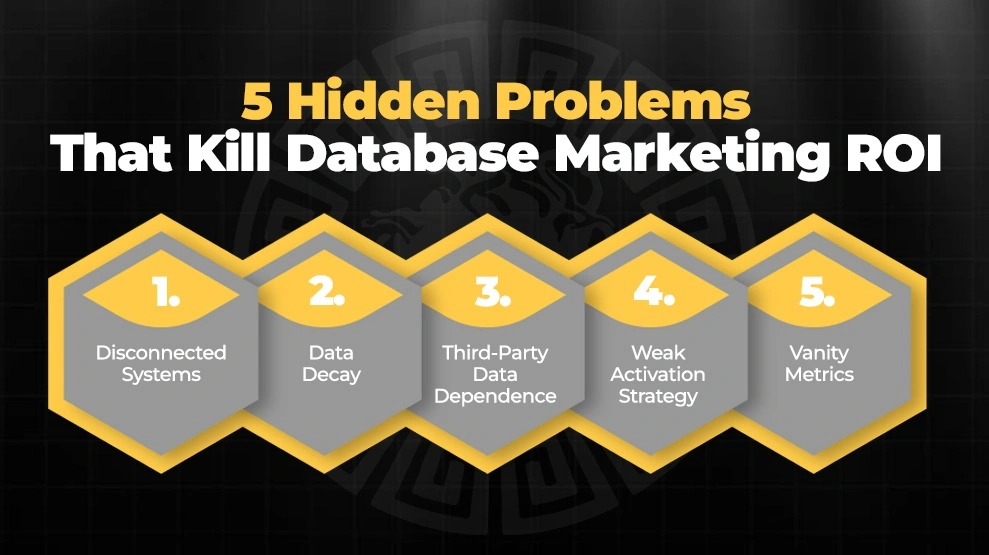
Below are the common database marketing challenges:
- Disconnected Systems: CRM, ad platforms, and other systems operate independently, creating blind spots. Resulting in no clarity.
- Data decay: B2B contact data naturally gets degraded over time due to changes in job roles, company shifts, and organizational restructuring.
- Overreliance on third-party data: Relying on the outsourced database from third-party data vendors and aggregators results in a lack of lead context and engagement validation
- Limited activation strategy: Many teams collect data but lack a clear plan to operationalize it across campaigns.
- Weak engagement validation: Vanity metrics such as clicks and form fills don’t indicate genuine buying interest
According to a Gartner research report, poor data quality costs organizations an average of $12.9 million annually.
These gaps are precisely why modern database marketing solutions are gaining traction among performance-focused B2B teams.
How to Build a High-Performing Database (Step-by-Step)
Building a high-performing database involves a structured process that starts with solid design principles, governance, and activation. Below are the foundational steps B2B organizations must follow:
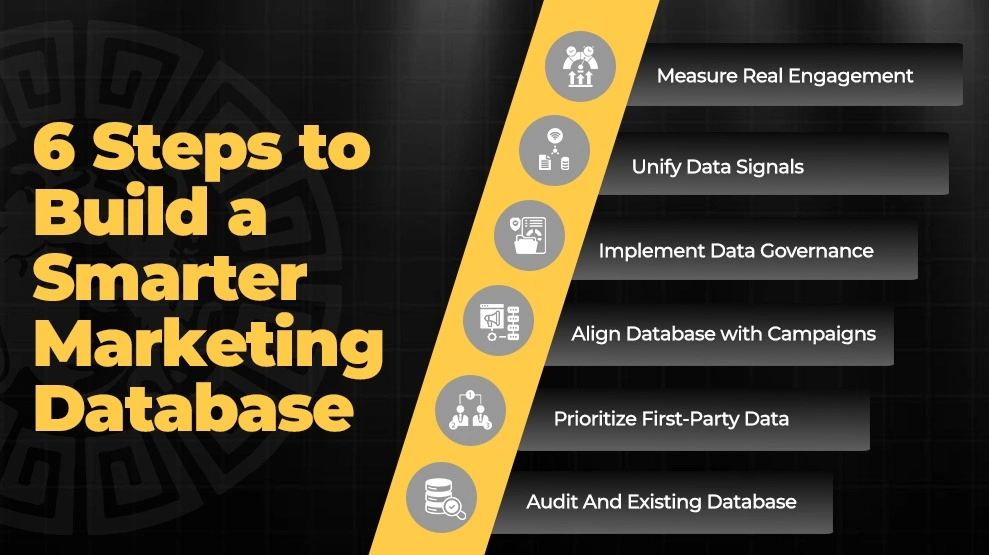
1. Audit And Clean Your Current Marketing Database.
Start by evaluating your data and maintaining data hygiene by:
- Data completeness
- Duplicate records
- Accuracy data
- Source reliability
- Field standardization
This step reveals where your B2B data management process is breaking down.
Even the professionals discover that when proceeding with data hygiene:
- Duplicate records
- Inaccurate, outdated contacts
- Missing firmographic fields
- Inconsistent formatting
A clean and well-maintained data foundation helps you to improve every downstream initiative, from segmentation to personalization.
Pro tip: Validating data continuously helps you operate procedures efficiently for measurable impact.
2. Prioritize First-party data over purchased data volume from vendors
First-party data = Genuine data
The data is collected directly from the audiences that interact with your content assets and aligns with your ICP. This data helps you provide behavioral clarity.
Leading B2B organizations rely on:
- Content consumption patterns
- Webinar participation
- Intent validation
- Regular cleansing cycles
- Engagement scoring
- Ad interaction via VM Engage
- Syndication signals through Verified Content Engagement.
First-party data reflects real intent.
And working with a first-party data marketing agency like Vereigen Media helps you accelerate progress.
3. Align Database Marketing with Campaign Activation
A high-quality marketing database should not operate in isolation.
Your database marketing solutions should connect seamlessly to:
- Content syndication programs
- Account-based marketing (ABM) programs
- Email nurturing workflows
- Sales outreach
- Marketing automation journeys
When your database marketing agency partner understands this full ecosystem, your campaign strategically moves accounts toward buying readiness.
4. Implement Rigorous B2B Data Management Practices
Strong B2B data management framework requires disciplined governance. Without it, even the most sophisticated marketing strategies struggle to deliver meaningful results.
Effective data governance should include:
- Standardized data fields.
- Regular cleansing and enrichment processes
- Role-based tagging
- Industry normalization
- Real-time validation workflows
- Privacy and consent tracking
Executives often underestimate data governance and organizations that treat data as a revenue asset consistently outperform peers.
Database hygiene helps you to improve campaign performance.
5. Unify behavioral and firmographic signals
Your database marketing strategy becomes far more powerful when you connect:
- Firmographics (company size, industry)
- Behavioral engagement
- Content consumption patterns
- Buying stage indicators
Consider this simple operational framework:
| Data Layer | Strategic Purpose |
| Firmographics | Target the right industries and company sizes |
| Demographics | Align messaging to role and seniority |
| Behavioral Data | Identify interest and readiness |
| Engagement Time | Validate content consumption depth |
When these layers are unified, the signals help you allow marketing and sales to prioritize the right accounts at the right time.
6. Measure what actually signals buying intent
In modern B2B marketing, executive teams are moving beyond vanity metrics toward deeper engagement indicators. The modern database marketing approach helps you track:
- Verified time spent
- Multitouch engagement
- Content interaction till depth
- Account progression
- Pipeline influence
This approach helps you to improve forecast confidence and budget allocation decisions.
What Are the Benefits of Database Marketing Services for B2B Leaders?
Many B2B organization executives are exploring a partnership with a database marketing agency to strengthen their marketing data infrastructure. However, not all database marketing solutions deliver the same level of impact, particularly when internal systems lack proper integration or a verification process.
Professional database marketing services provide you with:
- Human-verified data quality to improve accuracy and trust
- First-party data strength for content syndication strategies
- Time-based engagement tracking that reveals true interest.
- Privacy-compliant data governance
- Transparent reporting for pipeline visibility
Executive teams should evaluate partners that accelerate maturity while maintaining compliance and accuracy.
Why First-Party Data Is Crucial and How It Reshapes Database Marketing Strategy
First-party data is genuine and crucial for every critical mission, as it is collected directly from the interacting customers.
Privacy regulations changes lead to a decline in the use of third-party data.
Forward-thinking organizational teams are strengthening their marketing database by investing in:
- First-party audience development
- Verified content engagement signals
- Consent-based content ecosystems
- Direct audience engagement programs
- Time-based engagement metrics
- Intent-rich behavioral insights
This is where strategic partners like Vereigen Media differentiate themselves, through human-verified engagement models and first-party data frameworks, campaigns move beyond impressions and clicks toward validated buyer interest.
When database marketing integrates verified content engagement (VCE) signals, marketing and sales teams operate from the same intelligence layer.
Organizations that prioritize first-party data creates most impact and see:
- Higher campaign match rates
- Better lead quality
- Improved compliance confidence
- Stronger pipeline predictability
Bringing It Together: Smarter Campaigns Start With Smarter Data
Database marketing is not a tool. It is an operating philosophy.
When your marketing database is executed correctly and aligned by first-party engagement data, it’s impact extends far beyond campaign performance.
Smarter database marketing campaigns lead to:
- More precise audience targeting
- Sales conversations improvement
- Clearer attribution models strengthen campaign
- Improved forecasting accuracy
- Deeper buyer trust
For B2B leaders, the marketing database ultimately becomes the intelligence layer that connects marketing investments translate into revenue outcomes. Organizations that master database marketing are not simply running better campaigns, they are the one building predictable growth engines.
Ready To Turn Data Into Revenue?
Database marketing is evolving rapidly and the organizations gaining momentum are those treating data as a strategic growth asset. Smarter campaigns are beginning with disciplined database marketing built on verified first-party engagement.
If your team is ready to strengthen targeting, elevate lead quality, and build campaigns that deliver measurable pipeline impact for a strategic shift.
Book your free strategy session with Vereigen Media today and transform your first-party data into verified engagement and pipeline momentum.
Leads. Done Right.
Frequently Asked Questions on Database Marketing
Database marketing in B2B demand generation is a strategy where customers and prospects data has been stored in the CRM to set the personalized campaign targeted to the buyer’s need and their funnel stage. Here, to target the buyer’s prospects get relied on first-party data with human-verification helping to drive measurable revenue outcomes and enhance the overall campaign performance across the B2B funnel.
By relying on a clean, unified database you get better audience segmentation, more relevant messaging, stronger sales alignment, and improved conversion rates. No wasted spend seen with the database marketing as its relied on the first-party data to improve campaign ROI.
While looking for a database marketing solution, you must look for the tools that will help you in consolidating scattered customer data, support deep segmentation, and ensure compliance with privacy regulations. Also rely on first-party data strength, human verification, and real engagement signals.
First-party data is crucial as it improves compliance, accuracy, real engagement validation, and targeting precision for modern B2B campaigns. This genuine data also helps you in reducing dependence on unreliable third-party data vendors.
If your internal data governance is fragmented, engagement signals lack verification, or an inconsistent campaign you should partner with a database marketing agency. The database marketing agency helps you with verified data, engagement intelligence, full-funnel activation expertise, and impacts your revenue. Vereigen Media a U.S.-based demand generation agency is the one you can partner with and expect measurable business impact.
Written By –
