 Skip to content

The right companies matter most in the B2B industry more than the number of companies.
In B2B go-to-market strategies, revenue failure rarely comes from weak messaging or poor sales execution. More often, it stems from a quieter issue: teams are targeting the wrong companies.
When sales and marketing teams operate without a shared, reliable understanding of which accounts truly belong in the pipeline, even the strongest campaigns underperform. Budget is wasted, sales cycles feel longer, and alignment breaks down, not because teams lack effort, but because they lack precision.
This is where firmographic data becomes foundational.
Firmographic data provides B2B teams with structural clarity to define their market for measurable outcomes, while prioritizing accounts them, and align go-to-market execution around companies that can realistically buy, adopt, and scale.
In this guide, we’ll explore
- What does firmographic data mean in B2B?
- How firmographic data works in modern B2B environments
- Why it remains as one of the most reliable signals for aligning go-to-market teams.
You’ll also see how first-party firmographic data supports privacy-compliant growth, how to apply firmographic insights across lead generation, messaging, and B2B data targeting without distraction in your funnel.
What Is Firmographic Data?
Firmographic data is a firm and static data that reveals the attributes of companies. This data refers to company-level attributes that describe an organization’s structural and economic profile. It is the B2B equivalent of demographic data, but instead of individuals, it focuses on companies.
Firmographics help teams determine whether an organization or a business fits your ideal customer profile (ICP) before investing sales or marketing resources.
Common firmographic data points include:
- Company size (employees or budget)
- Geographic location
- Market capitalization
- Industry and business type
- Ownership model
- Organizational structure
Firmographic data is relatively stable compared to the behavioral intent data. That stability helps you define:
- Market Segmentation
- Territory Planning
- Account-Based Strategies
- Early-Stage Qualification
At its core, firmographic data clears the path by answering questions such as: how they make purchasing decisions, what challenges they likely face, or whether this company is large enough to afford our solutions.
Why Firmographic Data Matters in Modern B2B GTM
B2B buying decisions are more complex, committee-driven, and high-risk.
Without firmographic data clarity, GTM teams rely on assumptions, leading to bloated pipelines and poor forecasting.
Where B2B decisions are complex and involve multiple-stakeholders, firmographic data helps you:
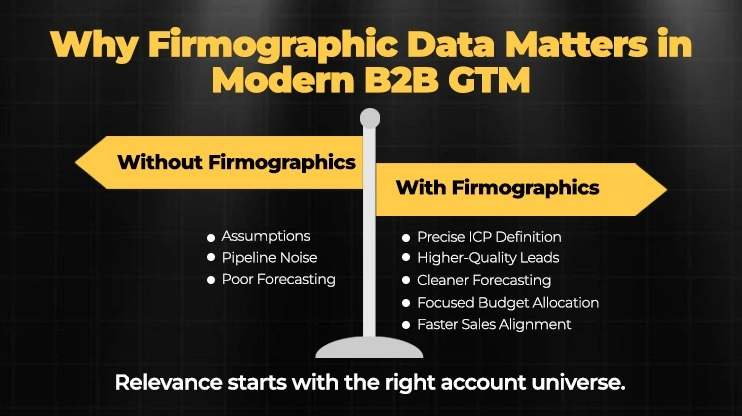
- Define your ideal customer profile (ICP) with precision
- Higher quality inbound and outbound leads
- Personalize messaging without over-engineering.
- Reduce lead leakage and time between the sales and marketing teams
- Focus spending and effort on accounts with real buying potential.
- Improve forecasting and pipeline quality.
Firmographic data provides structure and confidence, creating focus across the entire revenue engine. The strategic takeaway is simple and clear: Relevance starts with the right account universe.
Firmographic Data vs. Demographic Data
A confusion for a long run to end.
These data types are often confused, but they are crucial and serve different strategic purposes.
| Aspect | Firmographic Data | Demographic Data |
| Focus | Companies | Individuals |
| Used by | Sales ops, marketing ops, RevOps | HR, consumer marketing |
| Examples | Revenue, industry, HQ location | Age, job title, education |
| Best for | Account targeting, ICP definition | Persona development |
In B2B, firmographic data defines whether the account aligns with your pipeline, answering “Should we pursue this company?”
Demographic data answers “Who inside the company should we engage?”
Quick Read: How B2B Teams Use Technographic Data?
Firmographic Signals That Influence Buying Reality
Firmographic data is the characteristic information of the company that doesn’t influence the buying process but are essential and actionable as it defines feasibility.
1. Company Size
The company size varies as per the technology adoption, and the employee count of an organization often signals operational complexity, buying committees, and budget thresholds. A 50-person company buys differently than a 5,000-person enterprise.
2. Revenue
Revenue bands help set realistic expectations for deal size, pricing models, and contract structure.
3. Industry, Business Model, and Customer Type
Knowing the specific sector of an organization, such as industry, business model, or customer type, helps in precision targeting with relevant messaging.
4. Headquarters Location
Geographic location influences purchasing decision, compliance requirements, sales cycles, and even messaging tone in industries requiring on-site service, compliance with local regulations, or timezone support.
The characteristic information of an organization, such as, size, employee count, geo location, and financial metrics, helps you to understand the business performance.
How Firmographic Data Improves Lead Generation
Firmographic data is most powerful and delivers the greatest value even before the leads enter your funnel.
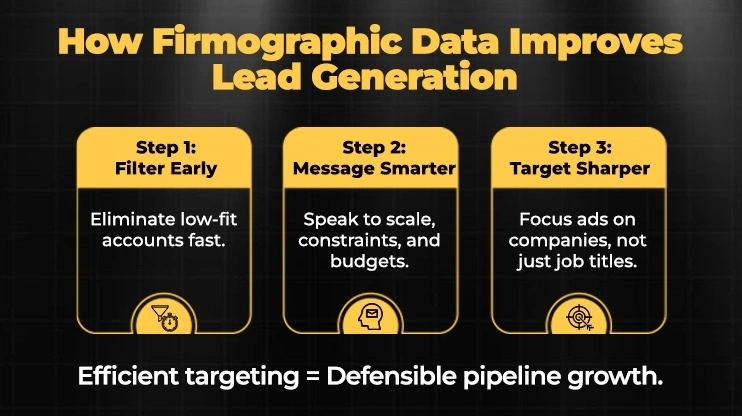
High-performing teams use it to:
1. Quickly Identify Qualified Sales Leads
Filtering and excluding the companies that don’t meet your ideal customer profile (ICP) criteria, helps you to reduce time spent on low-probability conversations.
2. Improve Sales and Marketing Messaging
Knowing a company’s size and industry allows teams to speak to real constraints, budget cycles, compliance needs, and operational scale.
3. Optimize Your Ad Targeting
Firmographic filters sharpen display and programmatic campaigns by focusing impressions on companies that match revenue and industry thresholds, not just job titles.
This is where B2B data targeting becomes more efficient, defensible, and measurable.
Where Is Firmographic Data Sourced?
Quality matters more than quantity for measurable business outcomes.
Firmographic data is typically sourced from trusted:
- Public records and regulatory filings
- Company disclosures and websites
- First-party engagement data
- Human-verified research processes
The challenge isn’t access, it’s accuracy and freshness. Firmographic data decays faster than most teams realize, especially in high-growth sectors.
How to Choose the Right Firmographic Data Provider?
Before selecting a data provider, GTM or the decision-makers like you should ask:
- Is the data first-party and transparent?
- How often is it validated by data experts?
- Is relevance prioritized over volume?
This is where data providers like Vereigen Media differentiate it by combining first-party, human-validated firmographic data with verified content engagement through content syndication and VM Engage, a display and programmatic advertising.
Leads. Done Right.
Advanced Strategies for Using Firmographic Data
The most effective strategy for firmographic data is to move beyond the basic segmentation to measurable outcome, through precise targeting, personalized outreach, and proactive data-driven decision-making.
Top-performing GTM teams:
- Build and refine dynamic ICP and account scoring models.
- Personalize outreach at scale and align territories around firmographic segments.
- Drive account-based marketing to target the precise customer, improving overall campaign ROI.
- Update the firmographic characteristic to reflect market shift as they vary with time.
- Maintain data that pairs firmographics with verified content engagement for context.
How to Gather and Utilize Firmographic Data Responsibly
Gathering and utilizing the firmographic data responsibly is essential for B2B sales and marketing efficiency. This helps you to approach with privacy-first, accurate, and ethical data.
- Responsible data gathering depends upon verified, compliant, and transparent trusted sources such as first-party data, reputable third-party data aggregators, or publicly available information.
- Whereas utilizing the firmographic data helps you to add value to the prospect by defining ICP, segmenting audiences for personalization, and enhancing customer experience.
By adopting these practices, you can build trust internally and externally that improve sales performance while maintaining trust and compliance.
Why Firmographic Data Remains Foundational in a First-Party World
As third-party data lacks trust, and most of the data has signaled weaken and privacy expectations rise, first-party firmographic data becomes even more critical. It solves the complexity and remains the foundational.
When combined with verified content engagement signals and human verification. It delivers relevance without intrusion, and scale without overreach.
Final Thoughts for B2B Decision-Makers
Firmographic data isn’t new, but its strategic importance has never been higher.
For CMOs, CROs, and RevOps leaders, the question isn’t whether you use firmographic data. It’s whether your organization is using it with discipline, accuracy, and intent.
If your team struggles and debates around lead quality, funnel leakage, or misaligned targeting, the answer often starts here.
Book your free strategy session with Vereigen Media today to explore how human-verified, first-party firmographic insights can sharpen your go-to-market strategy.
Leads. Done Right.
Frequently Asked Questions on Firmographic Data
Firmographic data in B2B marketing refers to company level information or attributes such as size, industry, revenue, and geographic location used to target potential customers for measurable growth.
Firmographic data is a firm, static data which describes how and what the company is, while intent data reveals the online behavioral signals, which is dynamic and what a company is doing in real-time. Firmogaphic data defines the ideal customer profiles that are potential for targeting, and intent data prioritizes the interested customers that are ready to buy right now.
Yes, firmographic data improves sales efficiency by improving alignment between sales and marketing, precisely targeting the high-value prospects, and reducing time waste on unqualified leads.
Every B2B companies are been benefited from firmographic data, which seeks to target specific, high-value prospects. The industries are tech, IT, SaaS, media, and other professional services which see a strong impact due to complex buying cycles.
Vereigen Media, a U.S.-based demand generation company approach firmographic data by emphasizing first-party, human-verified data combined with verified content engagement, ensuring accuracy, compliance, and relevance.
Written By –
