 Skip to content

Entering a new B2B market is not just a strategic growth initiative, it’s one of the most consequential decisions that directly impacts revenue trajectory, brand positioning, and long-term scalability.
Too often, B2B organizations assume that entering a new market or expanding their business is simply a matter of replicating past success. But in reality, modern B2B leaders know every new market, whether defined by geography, industry segment, or buyer group, introduces a different competitive dynamic, demand signals, and buying behavior.
Here’s why a thoughtful market entry strategy becomes critical.
Without a clear market entry framework, most companies stumble during expansion, and they often face slow adoptions, low-quality engagement, and extended sales cycles that delay pipeline impact.
The real challenge isn’t just launching into a new market, it’s building credibility, generating demand, and researching decision-makers who are already overwhelmed with competing solutions.
Today’s most successful B2B leaders take a different approach. They combine market intelligence, targeted content distribution, and validated audience engagement to ensure their strategy translates into pipeline growth as every fundamental remains the same.
To get clarity before commitment.
In this blog, we’ll explore how B2B decision-makers build a winning market entry strategy framework that reduces guesswork, aligns internal teams, and positions your brand to win from day one.
Why Do B2B Market Entry Strategies Fail in Modern B2B Expansion?
Growth pressure is increasing across B2B organizations, but speed without strategic alignment creates compounding risk.
Most of the companies now have become more competitive and interconnected than ever. Organizations now are expanding beyond their original territory to capture growth in new industries, geographic locations, and customer segments. Without proper structure, you’re wasting campaign budget by reaching the wrong audience with a generic message and wondering why it’s struggling to build your pipeline.
However. The expansion without strategy frequently produces disappointing outcomes and this leads to common consequences:
- Misaligned messaging that fails to resonate with new buyers
- Limited understanding of buyer decision cycles
- Sales teams targeting accounts that lack purchase intent
- Poor targeted marketing campaigns that lead to waste in marketing budgets and low-quality leads
- Insufficient demand generation to support sales teams
The core issue isn’t efforts or the budget, it’s a lack of validated direction to market entry.
A structured B2B market entry strategic framework helps organizations eliminate guesswork by grounding expansion decisions in data-validated demand and buyer intelligence.
Quick Read: How to Build a Go-To-Market Team That Delivers Predictable Revenue
The 5- Step Market Entry Strategy Framework
A well-designed and well-structured market entry framework provides the strategic clarity needed to enter new geo location or the market with confidence. The below mentioned five steps form the foundation of a scalable and repeatable approach.
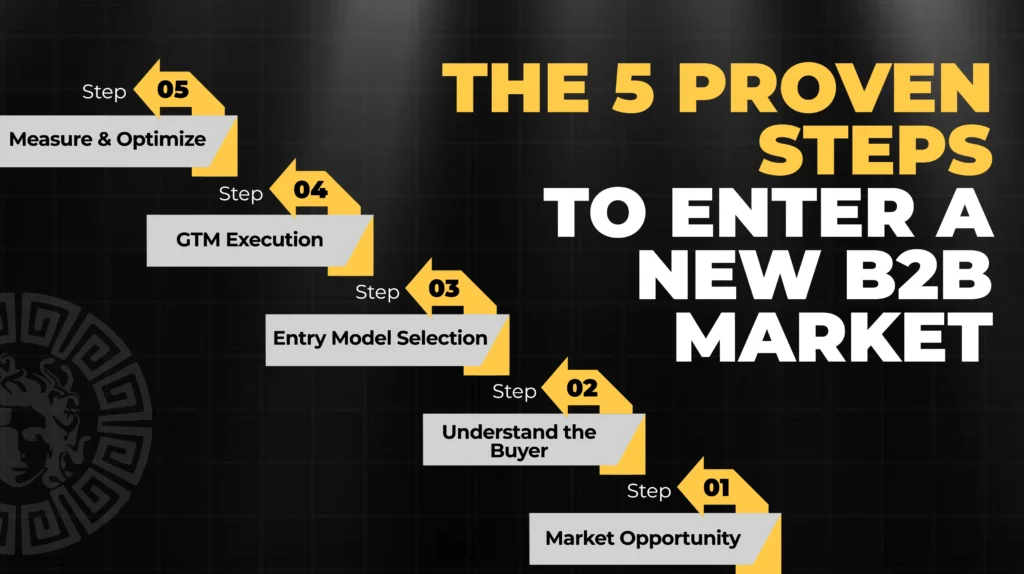
Step 1: Identify the Right Market Opportunity with Precision
The success of any market entry strategy begins by identifying and selecting the right market opportunity with precision, not just the largest one.
But in enthusiasm, many modern B2B leaders skip this step and rely on assumptions based on their existing strategy and here’s what the risk begins.
When moving beyond broad industry definitions, B2B leaders identify and evaluate several indicators when entering a new market.
- Total Addressable Market (TAM), SAM, and SOM
- Market growth velocity and competitive density
- ICP alignment within the target segment
- Verified buyer demand signal
- Regulatory and compliance factors for operational considerations
Modern B2B leaders use buyer intent data, first-party industry research, and genuine audience signals that align with your ICP to identify high-potential markets before committing resources in a full-scale launch. By identifying and validating the behavioral signals as downloading content assets and engaging with reveals where real demand exists. That’s the foundation of any credible market entry strategy.
But relying on surface-level metrics, which look attractive on the surface, lacks genuine buyer readiness, which results as an expensive mistake in B2B expansion.
Step 2: Understand the Buyer Before You Build the Plan
After identifying the market opportunity, its crucial to understand the buyer while defining your ideal customer profile for the new market, and here’s where your success actually depends.
Clear defining of the ideal customer profile is what states to be the strong market entry strategy framework for the new market.
Just knowing the market and the product is not enough, it’s crucial to understand the new market’s buyer equally as knowing them enables you to personalize the content aligning to the buyer persona which results in measurable impact.
Build detailed buyer personas for your new market entry by mapping:
- Titles and job roles involved in the purchasing decisions
- Pain points specific to the industry and company context
- Content formats aligning to the buyer’s need
- Average sales cycle length
- Technology environment and current solution stack
This isn’t the generic approach to executing campaigns, the engagement data, verified content engagement signals, and buyer’s behavior in the targeted segment help with the genuine crucial information.
Most common mistakes in B2B expansion occurs when organizations reuse the existing buyer’s information in the new market entry which differs in the location and buyer’s behavior.
Different markets often have different: purchasing structures, budget priorities, and buying cycles.
One of the most common mistakes in B2B market expansion occurs when organizations reuse the same ICP and audience assumptions that worked in their existing market.
Refining your ICP and considering the above mistakes ensure your marketing and sales are focused on the organization’s measurable success.
Step 3: Choose the Right Market Entry Model
Channel selection is where strategy becomes execution.
Choosing an entry strategy that balances control, cost, risk, and competitive positioning is crucial to know before deciding how you’re entering the market.
In B2B expansion, not every channel performs equally with the existing strategy or assumptions. Your every new market entry channel should be dependent on where your target buyers actually consume information and make decisions.
For most B2B decision-makers market entry models include:
- Content-led entry: Establishing though-leadership and organic demand before d
- Channel partnerships: Helps you provide faster access to established networks using resellers or agencies alliances.
- Direct sales: Building a field or inside sales team that allows maximum control to pursue accounts directly.
- Account-based marketing (ABM): Targeting specific accounts with personalized, multi-touch campaigns before directing outreach.
- Programmatic display advertising: Builds awareness and ensures your brand stays top-of-mind with key decision-makers.
For most B2B companies, a hybrid approach works best, especially when entering a competitive or unfamiliar segment. At Vereigen Media, our demand generation services programs including Verified Content Engagement (content syndication) and VM Engage (programmatic and display ads) are built specifically for B2B leaders entering new markets for measurable business growth.
Localized positioning by aligning the strategy to the market is known as revenue strategy. When your content aligns with the buyer’s intent conversion rates improve at every stage of funnel.
Step 4: Build Your Go-to-Market Execution Plan
Building your go-to-market execution plan is where the market entry framework is operational. This operational entry framework becomes a live revenue motion.
Your go-to-market (GTM) plan should include:
- Target account list (TAL) segmented by priority tier
- Sales model: Define your selling process (eg: channel partner, direct inside sales)
- Messaging framework: Personalized messaging aligning to each buyer persona and their specific pain points.
- Content and campaign strategy: Create valuable educational content personalized and mapped to each stage of the buyer journey to guide prospects from awareness to decision.
- High-impact channel usage: Use a few high-impact channels first like programmatic ads, content syndication network, email registration, and ABM reaching real buyers to the new market priorities.
Focuses on creating personalized content where B2B companies consistently place the content in front of verified decision-makers where your ICP is building credibility. Not in front of the audiences lacking engagement and precision.
Winning teams focus less on volume and more on relevance, timing, and verified engagement.
Leads. Done Right.
Step 5: Launch, Measure, and Refine in Real Time
The best market entry strategies are not a one-time launch plan and forget. It’s the process where you adapt with expansion, and your campaign framework gets sharper with every data point you collect.
With the launch to measure the right signals, not the vanity metrics, impressions, or follower counts.
Continuously validating the right genuine signals helps you with measurable impact and also separates you from the companies that scale from companies that stall.
The key signals to monitor when launch is:
- Engagement quality and conversion to opportunities
- Account penetration with target segments
- Depth of content consumption
- Pipeline velocity
- Active buyer intent signals
By measuring the above metrics from day one, avoid the trap of waiting a full quarter of data before making decisions. These signals actually tell you if your ICP definitions, channel mix, and messaging are working, or you need to refine sharper messaging or reallocate budget towards the highest-performing channels.
The teams that grow faster with the launch or entering into a new market are not due to aggressive moves due to proper measuring and refining the campaigns in real time by analyzing and validating the data signals.
What Separates Market Leaders from Market Entrants
Execution speed matters. But verified intelligence matters more.
The organizations that successfully expand and win into new marketplaces aren’t necessarily the ones moving fastest. They’re the ones moving with a clear understanding of their buyers, backed by validated data and aligned execution.
You don’t need to chase more leads.
You need the right interested audiences, from the right accounts that engage at the right time in their buyer journey where they build qualified pipelines with intent-driven engagement.
Ready to Enter Your Next Market with Confidence?
Successful B2B expansion isn’t driven by volume, it’s driven by precision and the organizations that win in new market entry are those that:
- Understand buyers deeply which are aligned with their ICP
- Validate demand before scaling
- Execute with data-backed confidence
For measurable pipeline growth and impact, you don’t need more leads.
You need qualified engagement from the right accounts at the right time.
Vereigen Media, a leading U.S.-based demand generation company helps B2B organizations identify high-potential markets, engage verified decision-makers, and build pipeline with measurable impact.
Book your free strategy session with Vereigen Media today to design a market entry program built on accuracy, intent, and real engagement that drives measurable business growth.
Leads. Done Right.
Frequently Asked Questions on New B2B Market Entry Strategy
A market entry strategy is a structured, comprehensive plan that helps B2B organizations to launch and introduce their product or services while expanding from one geographic location to other. This expansion and entry to the new market is primarily focused on proper planning, research, execution, and aligning to the buyer’s expectations to accelerate the pipeline growth.
The best market entry framework for B2B companies till date is the GTM framework which prioritizes precision targeting with market opportunity analysis, ICP definition, channel selection, and credibility over mass appeal. Layering this model with verified first-party data into each step ensures your framework is grounded in ABM and real buyer intelligence rather than assumptions.
B2B companies fail when entering new markets due to inadequate local market research, poor planning, failure to adapt products to local needs, and underestimating the local competition.
Vereigen Media, a U.S.-based demand generation company, supports B2B market entry through its proven solutions and a verified first-party database of 110M+ validated contacts. The solutions such as Verified Content Engagement, VM Engage, Smart ABM, and Event Registration ensure data accuracy, faster campaign launch, and real-time performance visibility, helping teams enter new markets with precision and speed.
Written By –
