 Skip to content


B2B organizations don’t struggle with a lack of data, they struggle with clarity.
And now in modern B2B, Clarity Data = First-Party Data
Every growth conversation today eventually leads to one critical asset: Business-to-Business (B2B) data. It’s far more than the contact records or the business info of a customer engaged with the content. Strategic b2b data solutions are built on verified, permission-based insights that inform targeting, personalization, and sales alignment. When combined with advanced b2b data analysis, they reveal who the buyers exactly are, how they have engaged, researched, and decide.
While most of the B2B organizations are drowning in dashboards and disconnected business info, a few of the forward-thinking strategies truly understand what is b2b data is in a way that drives revenue outcomes. The reality is simple: without a strong first-party data strategy, even the most advanced campaigns struggle to convert.
Organizations around the world are investing in disciplined first-party data strategy, scalable b2b data solutions, and deeper b2b data analysis, where companies replace guesswork with precision and build b2b data strategies that actually reflect buyer behavior.
In this blog, we’ll unpack what b2b data really means, how it has evolved, and why first party data strategy is becoming a revenue imperative that drives measurable growth.
What Is B2B Data and Why Does It Matter?
At its core, business-to-business data is informative and business information about other companies, including key decision-makers, budget, funding, intent signals, contacts, products, services, and other metrics. All of this collective information combined reveals the overall structural information of a company, like how they work, who the key decision-makers are, what its main challenges were, and other key aspects for the upcoming year.
B2B data, when properly structured and governed, B2B data supports:
- Account-based marketing programs
- Demand generation campaigns
- Pipeline forecasting
- Revenue attribution
According to Forbes, data-driven companies are:
- 23 times more likely to top their competitors in customer acquisition.
- 19 times more likely to stay profitable, surpassing competitors
- 7 times more likely retain customers
This b2b data helps you understand and analyze the data with relevant information about other businesses, identify, understand, and engage with the right customer accounts and decision-makers with precision.
What Makes B2B Data Valuable?
Not all data is equal.
But here, high-performing revenue teams evaluate B2B data against five criteria, ensuring the data is:
- Accurate: Data should be validated properly and cleaned
- Actionable: It should be aligned with your ICP to buying signals
- Timeliness: Reflecting current research behavior aligned with buying signals
- Compliant: It should be aligned with privacy regulations and accurate.
- Actionability: Data can be directly used for measurable growth
With this modern b2b data solutions intelligent and strategic pipeline is created, which makes the list stand out from the generic list providers.
The Core Components of Effective B2B Data Solutions
Modern B2B data solutions combine multiple intelligence data layers. Each layer plays a specific role while providing complete context in revenue execution.
1. Firmographic Data: Know Who You’re Targeting
This data solution helps you describe the structural profile of a company, such as company size, revenue, industry, geo-location, and growth stage. These metrics help you target the exact customer account aligning with your ICP.
2. Technographic Data: Understand Their Stack
This B2B data solution helps you know what tools, software, and platforms a company is currently using. This information is crucial for B2B marketers because it shows buying readiness and competitive positioning.
This technographic data helps you understand and turn cold outreach into informed conversations that matter for your pipeline growth.
3. Intent Data: Catch Buyers in Research Mode
Intent data helps you track and catch the digital footprints of buyers who are in researching solutions or the relevant topic similar to yours.
This includes downloading of a content asset, website visits, search queries, and genuine engagement with site reviews. Companies using intent data report converts faster, as they are engaging with the prospects in real-time.
4. Contact Data: Reach the Right Decision-Makers
Titles, roles, and validated contact channels ensure your outreach reaches real buyers, not outdated records.
The strongest B2B data services don’t just provide contact volume. They provide verified, contextual intelligence.
What Are the Types of B2B Data?
For executive clarity, B2B data typically works with several categories:
- Firmographic data is attributed data of a company
- Technographic data is the tech information of a company that it is using currently.
- Intent data helps you catch behavioral buying signals for measurable outcomes.
- Engagement data is collective information of your customers that interacted with your content asset.
- Contact data is a detailed decision-maker list that helps you reach the right decision-makers.
- First-party data is genuine data that’s collected directly from your owned audience that aligns with your ICP (content engagement, form fills, webinars, events).
Understanding how these layers work together is critical to building effective b2b data strategies.
How to Source B2B Data Responsibly
If you’ve asked, “How do I collect high-quality B2B data?” the answer lies in method, not volume.
High-quality sourcing includes:
- Content syndication with verified engagement (Verified Content Engagement = Content Syndication)
- Programmatic display campaigns (VM Engage = Display and Programmatic Ads)
- Webinars and gated assets
- Sales conversation feedback loops
- CRM enrichment and cleansing processes
Responsible B2B data collection requires governance frameworks, compliance oversight, and ongoing validation.
Why Most Companies Are Still Behind
Most of the companies are still relying on the traditional approach, using the data aggregated from vendors or outdated ones. These misconceptions cause brands erode.
Misconceptions revenue leaders must fix for measurable impact.
- High volume data for pipeline growth
- Relying on the generic metrics
- Vendors and aggregators solve the accuracy problem
This misconception leads revenue leaders to struggle with:
- Poor data hygiene
- Disconnected systems
- Inconsistent ICP definations
Without data analysis dashboard becomes noise.
First-Party Data Strategy: The New Competitive Advantage
What First-Party Data Really Means
First-party data is information you collect directly from your audience through owned interactions.
It includes:
- Content engagement time
- Form completions
- Event participation
- Website behavior
Why Third-Party Data Is Losing Trust
Privacy regulations and browser changes have reduced reliance on third-party cookies. Accuracy concerns continue to grow.
How First-Party Data Improves Revenue Outcomes
- Higher engagement accuracy
- Better compliance posture
- Stronger sales alignment
- Clearer attribution
For revenue leaders, a first-party data strategy is not optional. It is foundational.
Building High-Impact B2B Data Strategies for 2026 and Beyond
Make your B2B data actionable with the structured framework that matters. The following are the steps to build high-impact B2B data strategies for 2026 and beyond.
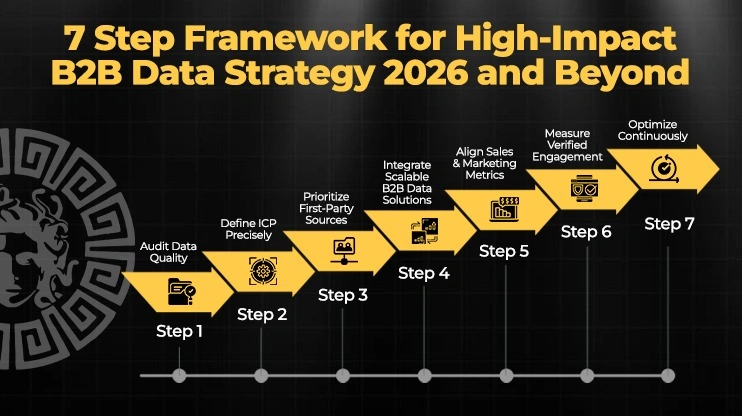
Step 1: Audit your current data quality
Audit your current data quality for measurable pipeline growth by evaluating it around accuracy, duplication, and completeness.
Step 2: ICP for precision
Define your ideal customer profile (ICP) with precision.
Step 3: Prioritize the first-party data source for the modern leaders.
As in modern B2B era third-party cookies disappear, you need to shift your campaign budget toward verified engagement programs. Relying on first-party data helps you with accurate targeting and compliance.
Step 4: B2B Data Solutions
Choose B2B data solutions that matter to your organizational growth which integrate seamlessly.
Step 5: Align sales and marketing data goals
Define shared metrics beyond MQL volume, which will help you reduce waste in budget and enhance the pipeline growth.
Step 6: Measure verified engagement
Track time spent, asset depth, and multi-touch activity.
Step 7: Optimize continuously and measure what drives revenue
Refine ICP definitions, scoring models, and segmentation quarterly.
B2B Data Is a Revenue Discipline
Revenue growth doesn’t depend on how much data you have, it depends upon how trustworthy, genuine, and actionable that data is across your revenue engine.
Your business-to-business data is not just a campaign supportive asset, it’s a growth lever for leadership roles.
Revenue leaders who invest in first-party data, verified engagement, and disciplined B2B data analysis position their organizations for predictable growth.
Organizations that taking immediate action now and prioritizing first-party engagement with human-verified insights are already ahead, building stronger pipelines, sharper targeting, and more confident forecasting.
Ready to transform your data into revenue performance?
Book your free strategic session with Vereigen Media today to modernize and transform your data approach for measurable revenue outcomes.
Leads. Done Right.
Frequently Asked Questions on B2B Data:
B2B data is informative data regarding the organization and their employees used to target them precisely for marketing, sales prospecting, and strategic decision-making. This data helps teams identify, target, and engage high-value accounts and improve pipeline quality and sales efficiency.
A first-party data strategy improves marketing ROI by focusing on verified engagement, privacy-compliant data collection, utilizing direct, consented insights, allowing for better personalization, resulting in higher conversion rates while ensuring accuracy and ownership.
Modern B2B data solutions improve lead quality by providing accurate, enriched, real-time data enabling precise targeting, technographics, firmographics, and relying on intent signals.
Company faces common challenges such as, data decay, siloed systems, poor governance, and lack of real engagement visibility.
The most important types of B2B data for revenue growth are intent, formogaphic, technographic, accurate content data, and engagement data. These data types allow team to identify high-fit accounts, reveal buying readiness, target and engage with the high-fit accounts to accelerate the sales cycle.
Vereigen Media, a U.S.-based lead generation company provides proven solution like verified content engagement, VM Engage, event registration, aligned to first-party intelligence, human-verified engagement, and privacy compliant demand solutions that help revenue teams focus on buyers who actually convert with real revenue outcomes.
Written By –
