Skip to content

In B2B marketing, visibility without engagement is wasted.
As the B2B advertising industry evolves, the industry is moving beyond the surface-level metrics, prioritizing accountability and performance. Spending on digital advertising results in most organizations with a familiar problem: high impressions, low engagement and unclear revenue.
The root cause lies in the advertising model itself.
Choosing between the direct and B2B programmatic advertising represent two distinct approaches, that directly impact data quality, audience relevance, brand trust, and sales outcomes. Where one B2B advertising model lies in an approach rooted in relationships and control, and the other relied on automation and data.
That’s why the debate around Programmatic vs. Direct ads matters more than ever.
By this you’re accountable for pipeline quality, and here you’re expected to justify spend to leadership, where:
- CFO’s want predictability,
- CMO’s want scale
- Sales teams want leads that convert.
In this blog, we’ll explore how direct vs. programmatic ads really work in B2B, strength, limitations and how both models provide practical framework helping B2B marketers determine which approach delivers meaningful, revenue-driven results.
Why B2B Advertising Models Need a Closer Look
As the overall traditional model has fallen apart and is struggling to keep the pace with the complex, digital-first buying journeys. And also, due to:
- Linear funnel doesn’t work
- Buyer’s expectation shift
- Misaligned metrics
- Longer purchase cycle
- Multiple buying committees
That’s where trust has become hard to earn and easier to lose.
Yet many organizations still rely on advertising models designed for speed and volume rather than the verified engagement.

According to Hubspot’s 2024 Marketing Strategy Report, 22% of marketers use display ads as part of their strategy.
The question isn’t which model is popular.
The question is which model supports high-quality B2B outcomes.
What Are Direct Ads in B2B Advertising?
Direct ads in B2B advertising are highly targeted and are designed to generate immediate, measurable responses from decision-makers that matches your ideal customer profiles (ICP). This advertising model involves buying placements directly from publishers, media platforms, or industry networks.
In B2B advertising environment, direct ads are used for:
- Sponsored placements on industry publication sites.
- Direct syndication partnerships
- Email sponsorships
- Newsletter placements to reach potential audiences that align with your ICP.
Here with this advertising approach, you can negotiate the placement, pricing format, and audience parameters. Unlike broad campaigns this advertising method involves personalized outreach, as emails and LinkedIn negotiated directly with publishers to promote qualified leads and sales.
Where Direct Ads Perform Well in B2B
Direct advertisement performs well by offering control and predictability, by targeting the high-intent professionals focused on brand trust and audience relevance.
Direct advertisement performs well with:
- Transparent ad placement
- Clear alignment with potential customers
- Stronger perceived credibility among senior buyers
Where Direct Ads Fall Short
Direct advertisement falls short as limitation shows up when scale and optimization matters. Due to poor execution, lack of brand visibility, and improper targeting the direct ads doesn’t perform well.
Common challenges introduced by direct ads are:
- Manual execution takes longer time
- Limited real-time optimization
- Limited scale across buyer roles
- Fixed ad placement that doesn’t adapt to buyer behaviour
Direct ads deliver visibility but are not verified to buyer intent. So, they look effective but are underperforming in pipeline contribution.
What Is Programmatic Advertising in B2B?
Programmatic advertising in B2B uses an automated platform to buy, place, and optimize ads in real-time. This advertising helps you to automate media buying using data signals, bidding, and audience targeting by aligning to the professional’s job roles, companies, content consumption behavior and other key attributes to serve ads across multiple platforms in real time.
In B2B, programmatic advertising is used for:
- Account based targeting
- Retargeting known buyers
- Display and native ads
- Awareness and mid funnel campaigns
According to Hubspot’s Report, US is expected to exceed $383 billion by 2027.
In B2B programmatic advertisement shines when precision and efficiency matters.
Where Programmatic Ads Excel
Programmatic advertising delivers speed, scale, and efficiency.
Strengths include:
- Broad reach across devices and platforms
- Real-time optimization
- Advanced targeting based on firmographics and behavior
- Faster testing and iteration
Where Programmatic Ads Struggle
Scale doesn’t always equal quality, especially in B2B.
Challenges include:
- Limited visibility into where ads appear
- Inconsistent audience verification
- Overreliance on clicks rather than time-spent engagement
- Risk of reaching non-decision-makers
Without human oversight, programmatic ads can generate activity without impact.
Programmatic vs. Direct Advertising: A Strategic Comparison
Quick Read: The True ROI of B2B Programmatic Advertising
When evaluating programmatic vs. non-programmatic advertising, the choice depends on balancing efficiency and ad placement, not on the manual or automation buying.
| Criteria | Direct Ads | Programmatic Ads |
| Audience Control | High | Medium |
| Scale | Limited | High |
| Transparency | Strong | Variable |
| Optimization Speed | Slower | Real-time |
| Engagement Quality | Publisher-dependent | Data-dependent |
| Best Use Case | Authority & trust | Reach & targeting |
This B2B advertising comparison makes one thing clear: neither model works in isolation.
How B2B Decision-Makers Should Choose the Right Model
Looking out for the advertisement model? Check out the key points that will help you to choose between direct ads and programmatic ads.
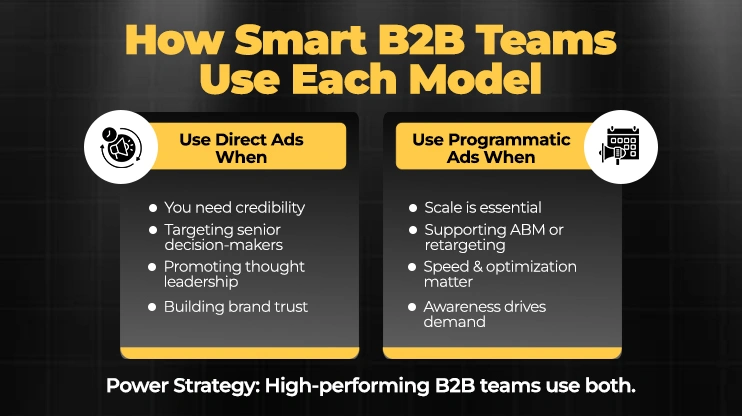
Direct Ads Work Best When:
- You’re targeting senior decision-makers
- Credibility and brand context matter
- You’re promoting thought leadership or gated content
- You need alignment with trusted publishers
Programmatic Ads Work Best When:
- You need scale across multiple accounts
- You’re supporting ABM or retargeting initiatives
- Speed and optimization matter
- You’re reinforcing awareness or consideration
Most of the high-performing B2B teams don’t choose one, they make sure to enhance the measurable outcomes by using both the advertising.
Leads. Done Right.
Why Engagement Quality Matters More Than Impressions
Clicks don’t equal real interest. Impressions don’t equal intent.
That’s why modern B2B advertising must prioritize verified content engagement (VCE) a content syndication solution.
When ads are measured by:
- Time spent with actual engagement with content
- Real human interaction verified manually
- Verified professional audiences that aligns with your ICP
Marketing leaders gain clearer signals of buyer readiness and sales alignment.
This is where approaches like content syndication paired with display and programmatic ads outperform standalone tactics.
How Vereigen Media Approaches Direct and Programmatic Ads Differently
Vereigen Media doesn’t treat direct vs programmatic advertising as competing models. They are complementary tools within a single, human-verified strategy.
Their approach combines:
- Verified Content Engagement through its content syndication solution
- VM Engage solution for display and programmatic ads
- First-party, privacy-compliant data
- Zero outsourcing and human verification
The result is advertising that reaches real decision-makers and measures what actually matters, attention, engagement, and readiness.
Not volume. Not vanity metrics.
Just outcomes.
Making the Strategic Choice That Serves Revenue
If your goal is awareness alone, almost any model works.
If your goal is pipeline contribution, sales alignment, and trust with leadership, the decision becomes more nuanced.
The most effective B2B advertising strategies:
- Balance reach with relevance
- Combine automation with human validation
- Measure engagement, not just exposure
And they evolve as buyer expectations change.
Ready To Optimize And Align Your B2B Advertising Approach With Real Buyers?
Choosing between direct and programmatic advertisement depends upon what you’re trying to achieve and how you define success.
Making decision on your plan impacts pipeline health, sales confidence, and long-term growth. If you’re evaluating programmatic and direct ads and want clarity, not complexity, now is the right time to reassess your approach.
Book your free strategy session with Vereigen Media today and discover how verified content engagement help you drive measurable pipeline B2B outcomes.
Leads. Done Right.
FAQs: Direct vs. Programmatic Ads in B2B
The biggest difference between lead generation vs. lead nurturing is: Lead generation creates new opportunities, interest, while attracting and capturing the prospects. Lead nurturing builds relationships and trust over time while helping prospects move toward a sales-ready decision.
A company should hire or invest in lead nurturing services or an agency when they are generating leads but struggling with conversion, meeting quality, and pipeline velocity turning leads into paying customers.
Yes, B2B companies need both lead generation and lead nurturing strategies to build a sustainable profitable pipeline that convert interest into revenue.
Yes, a specialized lead nurturing agency such as Vereigen Media helps you improve conversion rates by improving quality, timing, and sales readiness.
Written By –