Skip to content
In today’s rapidly evolving, AI and automation-driven business environment, organizations across industries are adopting generative AI to remain competitive and resilient.
In B2B marketing creating the content or the strategy takes around 1-2 weeks aligning with the current trends, but later it feels outdated. This is because the market shift and staying updated with the current trends, you are supposed to be quick in research, tasks, content creation and strategy too.
Maintaining the pace is essential or else you’ll be nowhere in the current trends.
B2B marketing leaders face an impossible equation: create personalized content at scale, with tighter budget, support sales, and still prove ROI. Traditional content creation processes can’t work in parallel with buyer’s expectations or market velocity. Generative AI doesn’t replace your marketing team, it amplifies strategic capabilities. When applied strategically, it helps B2B marketers move from reactive execution to proactive, insight-driven engagement, aligning content more closely with how modern B2B buyers, research, evaluate, and decide.
According to Gartner research 80% of organizations will deploy gen AI applications or will be using it by 2026.
The question isn’t whether to adopt AI for B2B marketing, it’s how to implement Gen AI to drive measurable outcomes. Currently, Generative AI has become a strategic capability worldwide that influence pipeline velocity, brand authority, and revenue performance for measurable outcome.
In this blog, we’ll explore how generative AI in B2B marketing is reshaping content creation, distribution, marketing strategy, and revenue alignment across B2B organizations.
What Is Generative AI in B2B Marketing?
Generative AI refers to a system that creates original content output, visuals, data summaries, audio, code, and other creative assets based on patterns learned from large datasets. In B2B marketing that capability is applied to interpret buyer intent, accelerate content development, campaign execution, buyer engagement, and sales enablement across channels.
Key applications in a B2B environment include:
- Strategic content ideation and planning
- AI-assisted content creation
- Predictive audience insights
- Campaign personalization at scale
- Sales and marketing alignment
Unlike traditional automation tools, generative AI doesn’t just execute tasks, it adapts and produces
outputs that resemble human-written and personalized to the prospect’s pain points. This is due to interactions and the learning patterns supported by the decision-makers.
Why B2B Teams Are Turning to Generative AI Now
B2B teams are rapidly adopting generative AI, as the buying process has now grown longer, more complex, and more content-driven. Still, most of the B2B organizations rely on linear content workflow as manual research which results in slow content production cycles, limited personalization, and reactive campaign execution.
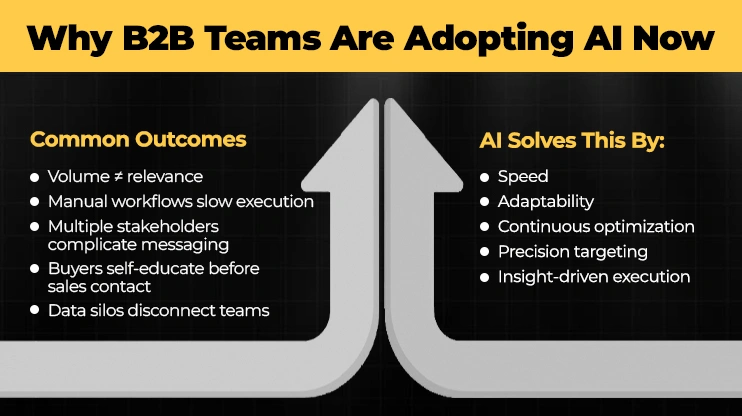
This traditional approach struggles under today’s conditions for several reasons:
- Volume does not equal relevance
- Multiple stakeholders involved in traditional process influence decisions.
- Manual content workflow takes more time
- Buyers self-educate before engaging vendors
- Sales cycles are longer and more complex
- Data silos disconnect marketing and sales teams
Generative AI addresses these challenges by introducing adaptability, accelerating execution, intelligence, and improving precision in the content lifestyle. Instead of producing content first and analyzing performance later, AI enables continuous optimization informed by real buyer signals.
This is where Generative AI in B2B marketing begins to reshape the equation along with the evolving B2B industry.
How Generative AI Transforms Content Creation
Generative AI transforms content creation by enabling rapid, automated production of text, image, code, and audio that significantly aligns with measurable business outcomes. Generative AI tools for marketing helps in creating content by analyzing large data sets, recognizing patterns, and producing content outputs that matters at speed.
Key applications of generative AI in B2B marketing include:
- Drafting content outlines and first drafts
- Supporting topic ideation based on search and intent signals
- Repurposing long-form content into multi-channel assets
- Assisting with personalization at scale

1. Strategic Content Ideation Backed by Data
Consistency across marketing platforms matters the most. But creating content and strategy in brand tone faster, doesn’t provide you with the faster results.
Generative AI supports consistency while maintaining tone, terminology, and messaging across blogs, display and programmatic ad campaigns, email, and content syndication. When aligned with human insights and review, it helps strengthen the voice rather than diluting it.
Rather than working in the silos, teams can:
- Identify high-intent theme earlier
- Reduce guesswork
- Align content with buying signals
This shift improves both efficiency and impact of the overall marketing campaign by aligning and prioritizing content that aligns with real buyers.
2. Faster Production Without Sacrificing Quality
With the evolving industry nature speed matters for the effective outcome and helps you focus more on the strategy, validation, and refinement.
Generative AI accelerates early-stage content by:
- Research synthesis
- Outlining the first draft and framework
- Repurposing the valuable long form content assets
- Adapting the content tone across the industry and personas.
- Faster campaign launches
Most effective teams worldwide combine AI speed with human expertise to ensure credibility and trust.
3. Personalization at Account and Buying-Group Level
Modern B2B decisions are now taken by multiple stakeholders, each with distinct priorities. Generative AI aligns the content with different stakeholders from different teams while managing the unified narrative. This mostly helps with the generative AI in sales and marketing where alignment matters.
With AI in B2B marketing organizations personalize the message by:
- The buyer’s job role in a buying group (CMO, CIO, procurement, finance)
- Industry context
- Stage in the buying journey
This capability of personalized messaging helps everyone supporting account-based strategies by delivering relevant content aligning the pain points and reflecting on how decisions are made. Rewriting all from scratch.
Quick Read: Top 9 Content Marketing Benefits That Actually Move the B2B Pipeline
Generative AI’s Impact on B2B Content Strategy
Generative AI is now transforming B2B content strategy from a manual process to an automated, data-driven personalized approach that aligns with buyer’s expectation.
This evolution enables:
- Real-time content optimization
- Faster response to market shift
- Aligning with content and revenue goals.
1. Strategy shifts from volume to impact
Creating huge volume of content doesn’t mean great impact.
AI enables teams to analyze content performance, by accounts, role, stage and so thus the strategy shifts toward relevance and verified engagement.
2. Hyper-personalisation and SEO at scale
Apart from one size fit message, at modern strategy hyper personalization content that aligns with buyers is must, and inserting the keywords with SEO perspective makes you actual convert.
It helps you identify:
- High-intent long-tail queries
- Content topic aligned with deal acceleration
- Optimization opportunity that goes beyond keywords
3. Data-driven strategy and insights
AI help you analyze vast amount of data to predict future, analyze competitors content and search queries to fix the gap ensuring higher ROI.
4. Human And AI Collaboration
With Human and AI collaboration they handle content strategy, brainstorming, optimization, storytelling, and emotional intelligence. This helps you ensure it meets high-quality standards.
A Brief Look at How Generative AI Got Here
Generative AI here didn’t appear overnight. Not in the early 20’s
The generative AI has rooted back from 1964, when MIT scientist Joseph created ELIZA, one of the first conversational program.
In modern era, i.e. in 2022 LLM large language model came into existence to generative contextual, long-form content at scale.
What’s changed now is accessibility and expectation.
Using Generative AI Responsibly in B2B Marketing
For decision-makers, success depends on balance:
- Use AI to accelerate, not replace, expertise
- Anchor outputs in verified data
- Measure engagement quality, not just volume
- Maintain transparency and compliance
When applied thoughtfully, AI for B2B marketing becomes a force multiplier for strategy, creativity, and performance.
Turning AI Potential Into B2B Performance
Generative AI in B2B marketing is transforming how content is created, researched, distributed, optimized.
The organizations winning today aren’t chasing generic content. They are using AI to support and match the pace of the evolving marketing era and buyer’s expectations. This helps them with more smarter decisions, stronger engagement and more meaningful buyer relationships.
For B2B decision-makers, the opportunity is clear: when guided by data integrity, and human expertise generative AI becomes a competitive advantage, not a risk.
Ready to scale content intelligently and drive meaningful outcomes?
Book your free strategy session with Vereigen Media today.
Leads. Done Right.
Frequently Asked Questions on Generation AI in B2B Marketing
Generative AI in B2B marketing uses the machine learning model to create content, strategy, campaign execution, recommendations and sales enablement that helps B2B teams with personalized campaign to improve decision making.
Generative AI tools for marketing helps you accelerate the process of content creation, improve personalization, optimizations, reduce manual efforts, and boost efficiency without sacrificing relevance.
Yes, generative AI improves ROI in B2B marketing when applied strategically and paired with strong data and human insight. It helps you improve ROI in B2B marketing by reducing content creation cost, shortening campaign cycles, improving targeting accuracy, and increasing lead generation that drives higher sales ROI by focusing on high-intent accounts.
Predictive AI in B2B marketing analyzes the historical and real-time data and helps in forecasting buyer intent, prioritizing buyer’s accounts, optimize campaigns, and guide in smarter go-to-market decisions with greater accuracy.
Written By –