Skip to content
Buyer purchasing journey has been changed with the evolving era: quietly, structurally, and permanently.
For years, B2B marketing on a familiar assumption: one buyer, one decision-maker, with one set of needs, thought process, and journey. That model no longer reflects how modern B2B decisions are made.
Today, the buyer you’re targeting rarely acts alone, or they don’t exit. The idea of targeting a single person and selling the services or product is now officially outdated. Most B2B purchases are driven by buying-groups were a group, cross-functional teams of 6-10 stakeholders, each with distinct priorities, risks, and long buying cycles that shape and make the decision.
But in many of the purchase cycle, the buyers are being treated as a single persona leaving the real decision makers behind the deal.
This shift has given rise to more precise and realistic approach: buyer generation. At its core is one essential concept, buying group personas.
Here, in this blog we’ll explore and understand the most important buying group personas involved in B2B decisions, what each role cares about and how they engage with the valuable content to effective Account-Based Marketing (ABM) programs.
What Are Buying Group Personas?
Buying group personas are the collective set of multiple individuals involved in a B2B purchasing decisions with distinct roles. Instead of focusing on one individual, they reflect the collective nature of decision-making inside modern organizations.
Each role involved within the buying group:
- Has unique goals and KPIs.
- Consume valuable, well-researched content.
- Evaluate risks and influence decisions differently.
- Has unique success metrics with different proof points.
In complex B2B sales cycles, buying process may involve distinct roles each evaluating risk, value, and outcomes through their own research process. Where the B2B decisions here are collective decisions that lead away from the generic messaging reaching the entire buying groups.
Why Buying Group Personas Matter in Account Based Marketing
Account-Based Marketing (ABM) is built on the precision, where your targeted accounts: the B2B buyers are moved down through the funnel in a defined path. Success depends on engaging the right account with the right content at the right time.
Here’s why the buying group personas are critical to ABM, because:
- The content is aligned to the job roles, department, and pain points.
- Support longer sales cycles with multi-touch engagements.
- Increase deal confidence by educating all decision-makers/stakeholders feel informed.
- Reduces internal team friction such as sales and marketing team.
In short, buyer generation starts when teams understand how the decisions are actually made, inside target accounts and design content that speaks to the entire buying group.
The Core B2B Buyer Roles You Need to Know
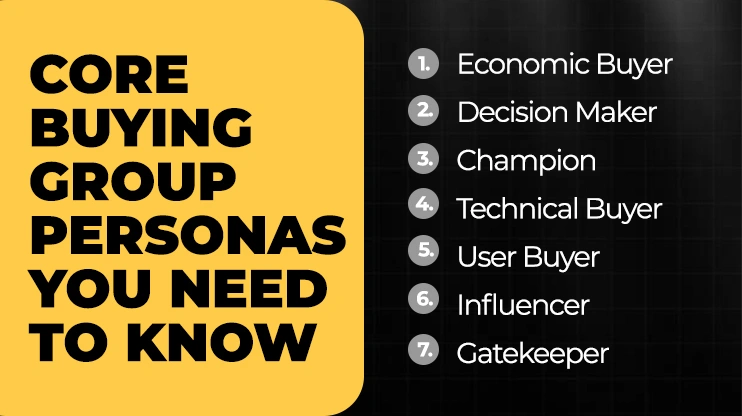
While buying groups vary by industry and deal size, most B2B purchasing decisions include the following roles:
1. The Economic Buyer (The Budget Owner)
The economic buyer controls, or heavily influences, the budget approval. They may not evaluate features or implementation details, but they focus heavily on financial outcomes:
What they care about:
- Cost justification and total cost of ownership.
- Risk mitigation
- Long-term business value
- Revenue or efficiency impact
What resonates:
- Clear ROI narratives
- Business impact metrics
- Cost of inaction insights
2. The Decision Maker (The Final Approver)
Decision-makers are the one who holds the final sign-off authority. They consider every input from the internal teams and weigh them accordingly on the basis of:
- Strategic alignment
- Competitive differentiation
- Organizational readiness
The final approver has the overall brand and vendor credibility. That resonates:
- Market positioning insights
- Credible case studies
- Clear differentiation
Common mistake: Treating decision-makers as budget owner or technical reviewer.
3. The Champion (The Internal Advocate)
Champion is the strongest which helps you in pushing the momentum forward in the buying group process. They believe in solving a known problem and driving a change internally.
How to identify them:
- Repeat engagement with content
- Internal sharing and advocacy
- Cross team alignment.
- Proactive communication
Content that supports champions:
- Problem solving thought leadership content
- Shareable industry insights
- Clear positioning narratives
- Valuable content that helps to share internally
What helps them turn on:
Content that makes them work harder to explain value.
4. The Technical Buyer (The Evaluator)
The technical buyer is the one that has concern over functionality, integration, performance, and feasibility.
The technical buyers help you in validating whether a solution is viable or not. They influence the decisions by evaluating and identifying:
- Integration risks
- Security implications
- Scalability concerns
- Implementation complexity.
Effective content that resonates for the personas are:
- Product architecture explanations
- Technical FAQs
- Proof of compatibility.
Common mistake: Skipping the persona and the effective content part at early stage.
5. The User Buyer (The Day-to-Day Operator)
Primary concern: Usability and impact on workflow
Key question: Will this make my job easier, or harder?
These are the people who actually use the solution. Their influence comes from:
- Adoption likelihood
- Productivity impact
- Feedback to leadership
- Resistance, or advocacy, during rollout
What resonates:
- Real-world use cases
- Workflow examples
- Ease-of-use messaging
- Stories from peers
Common mistake: Ignoring this role because they don’t “sign the deal.”
Quick Read: The Importance of Understanding Your Business Buyer’s Persona
6. The Influencer (The Trusted Voice)
A trusted voice in the b2b buying group personas that validate and gives credibility shaping opinions. They don’t own any budget or the approvals, but their opinions carry weight.
Influencers such as consultants, internal subject matter experts, and industry peers doesn’t care about budget or the approvals, but they care more. They care about the best practices, research backed content, validation, and industry credibility.
Effective content for this persona are:
- Trend analysis
- Thought leadership blogs
- Expert perspective
ABM Tip: Build trust by educating by providing the valuable content assets.
7. The Gatekeeper (Risk Manager)
The risk manager manages the access, compliance, and the procurement processes. This persona often appears late in the cycle but can stop the deals instantly. This persona has been evaluated by:
- Data privacy
- Compliance standards
- Risk avoidance
- Vendor credibility
Ignoring the gatekeeper persona is one of the most common ABM mistakes.
Effective content for this persona are:
- Compliance explanations
- Trust signals
- Policies
- Certifications
- Risk mitigation narratives
How Buyer Generation Differs from Traditional Lead Generation
In B2B Buying Generation:
Lead generation focuses on capturing individual leads, whereas buyer generation focuses on engaging buying groups with multiple stakeholders.
This shift changes everything for measurable impact.
Buyer generation prioritizes:
- Time-spent engagement over clicks
- Account-level insight over contact volume
- Content relevance over campaign noise
- Human behavior over automation assumptions
Here, buyer generation asks: “Who engaged, how deeply, and what role do they play?”
This is what crucial in the ABM, where success depends on coordinated engagement across multiple stakeholders inside the same account.
Why Buying Group Personas Matter Now
B2B buying has become more cautious, more collaborative, and more complex.
Buying group personas aren’t a trend, they reflect how decisions actually happen.
Organizations that adapt to this reality:
- Build stronger pipelines
- Shorten sales cycles
- Improve deal confidence
- Create more meaningful buyer relationships
Those that don’t continue to struggle with stalled deals and conversions feel unpredictable.
Buyer Generation Starts with Understanding People
At its core, buyer generation isn’t about technology or tactics, it’s about understanding people inside organizations.
When you stop marketing to a single buyer and start engaging the entire buying group, everything becomes clearer:
- Messaging improves
- Engagement deepens
- Trust builds naturally
And that’s where modern sustainable B2B growth begins.
Ready to Activate Buyer Generation That Reflects Reality?
Buyer generation works when your strategy reflects how decisions are actually made. If your team is ready to align Account-Based Marketing with real buying group behavior, it’s time to rethink personas, not as static profiles, but as living decision frameworks.
Book your free strategy session with Vereigen Media today and turn buying groups insights into actionable opportunities that move deals forward.
Leads. Done Right.
FAQ’s on Lead Conversion Metrics Every B2B Team Should Be Tracking
Buying group personas in B2B marketing represent the different roles involved in a B2B purchasing decision, each with unique priorities and influence.
Buying group personas are the one that are focused on the roles reflecting on the collective decision making across multiple stakeholders, such as influencers, blockers, and interactions. Whereas the buyer personas are the individuals focusing on the demographics, goals, and pain points.
Buying group personas are crucial for ABM, as they allow for precise, personalized engagement with multiple stakeholders from 6-15 which are involved in the purchasing process, where every stakeholder influences the deal.
In the B2B purchase decisions, multiple stakeholders are involved which are around 6-15 buyer’s group of an organization, especially in mid-market and the enterprise buying environment.
Buyer generation focuses on engaging real people across the buying group, building trust and intent before leads convert, leading to higher-quality pipelines.
Written By –