Skip to content

A strong product doesn’t always win in B2B.
The better product sometimes loses to a competitor, with a clearer positioning, a personalized message, and a sales team that knows who they’re selling to.
Even if the B2B leaders notices they have strong offerings, strong product, services, and capable team. They see:
- Pipeline inconsistent and unpredictable
- Sales cycles seemed longer than expected.
- Revenue gets stalls
- Leads looked qualified but deals stall.
The issue isn’t always the product or the service placement. It’s the absence of a defined go to market model.
In this blog, we’ll explore what GTM model is, the GTM meaning in a modern B2B context, how it differs from a campaign or channel plan, and why every B2B organizations especially the one that are selling complex solutions, needs a structured, data-driven GTM foundation to drive consistent, scalable revenue..
What Is a Go-To-Market Model (GTM Meaning) in B2B?
If you’ve searched “what is GTM model” or “GTM meaning,” you’ve probably found definitions that sound technical, generic and doesn’t exactly clear the doubts.
Here’s the practical explanation what B2B leaders should actually have a look on:
A Go-To-Market (GTM) Model is a strategic blueprint that used to launch a product or service, and where businesses proceed with the detailing while connecting the dots between:
- Who to target (ideal customer),
- How to reach them
- How to communicate and position your brand
- Where to show up
- How to generate demand and revenue.
- How sales wins deals
- How success helps in retaining customers
A GTM model is a strategic blueprint for success.
This approach helps the marketing, sales, and internal teams to get aligned for faster and more efficient market entry for measurable growth.
In B2B industry, every business needs the one GTM model which can minimize launch failure, aligns with internal valuable resources, reduces costs while clarifying customer values, and build trust by ensuring that only right message reaches the right buyer efficiently, preventing market confusion and wasted efforts.
What a Go-To-Market Model Includes (What Most Teams Miss)
A strong go to market model is built on decisions, not on the assumptions.
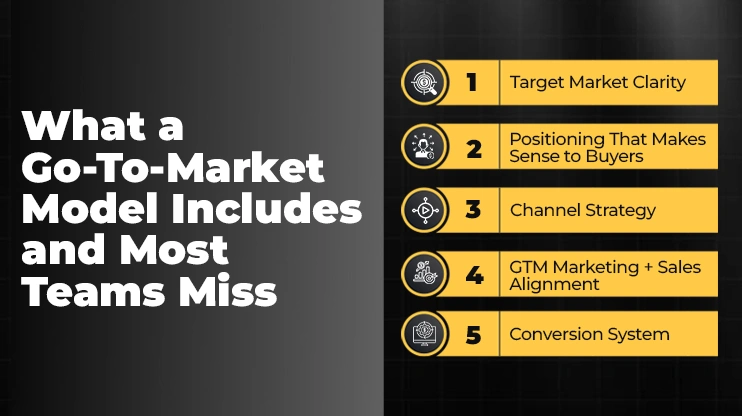
Here are the key components every B2B GTM model should include:
1) Target Market Clarity
When selling your product or your service across the market, it’s not that you are pitching or selling your product for everyone who might need it later.
But you should sell to the buyers with the real business problem, real urgency, and real buying power.
Your GTM model defines:
- Ideal customer profile (ICP)
- Decision-maker roles (CEO, COO, VP, Director)
- Industries and segments you’re built to win
- Deal size and sales motion fit
2) Positioning That Makes Sense to Buyers
Your buyer doesn’t want features.
They want outcomes that help them with:
- Less risk
- More efficiency
- Faster execution
- Better ROI
- Stronger performance
Your go to market marketing becomes effective when your message is aligned to how buyers evaluate solutions.
3) Channel Strategy
Your GTM model clarifies where growth comes from:
- Content syndication (verified content engagement)
- Display and programmatic ads (VM Engage)
- Organic content & thought leadership
- Partner ecosystems
- Outbound & intent signals
- Events and webinars
Without channel clarity, spend gets scattered. Results get inconsistent.
4) GTM Marketing + Sales Alignment
If marketing is generating one type of lead and sales is chasing another, performance collapses.
Your GTM model defines:
- Lead qualification standards
- Handoff process
- Follow-up timelines
- Sales enablement requirements
- Shared pipeline definitions
5) Conversion System
A GTM model answers the practical question:
“How do we move a B2B buyer from awareness to revenue?”
This includes:
- Funnel design (TOFU → MOFU → BOFU)
- Content mapping to buyer stages
- Email nurture logic
- Retargeting support
- Sales sequences and talk tracks
Why Every B2B Company Needs a GTM Strategy
Some B2B leaders assume GTM work is only for:
- Startups launching a product
- Companies entering a new market
- Teams building a brand-new demand gen function
That’s not the right thinking:
A GTM strategy is what matters most, when you’re trying to scale what already works without losing control.
A GTM model becomes essential when:
- Growth has plateaued
- Sales cycles are getting longer
- Lead quality is inconsistent
- Your pipeline is active, but close rates are low
- Your message doesn’t resonate like it used to
- You’re investing in ads, but ROI is unclear
A GTM model brings focus back to fundamentals.
What’s the Difference Between a GTM Strategy & Go-To-Market Model?
Many executives ask: what is GTM strategy, and how is it different from a go-to-market model?
Here’s the simple breakdown:
- GTM Strategy is your detailed plan to win in a market
- Go-To-Market Model is your operating system that help you to execute your plan repeatedly
Your strategy might include:
- “Target enterprise finance teams”
- “Win with compliance + security differentiation”
- “Build pipeline using content syndication and paid media”
Your go-to-market model is how you actually deliver it every month, every quarter, across every team.
Strategy can be inspiring.
Models are what create outcomes.
How GTM Planning Prevents Expensive Growth Mistakes
The reason GTM planning is so valuable is because it protects you from “false progress.”
B2B teams often feel busy but don’t feel confident.
You might be:
- Launching campaigns monthly
- Producing content weekly
- Building new landing pages
- Running paid media
- Hiring SDRs
- Attending events
And still wondering why pipeline isn’t predictable.
That’s what GTM planning fixes.
It forces your organization to answer uncomfortable questions early:
- Are we targeting the right accounts?
- Is our offer clear enough to create urgency?
- Do we have a differentiated message?
- Can sales close what marketing generate?
- Do we know which channel performs best?
Good GTM planning turns activity into efficiency.
Go-To-Market Marketing That Builds Trust (Not Just Traffic)
B2B buyers don’t convert just by seeing your content or your brand logo.
They convert because:
- They recognize your expertise
- They understand your value
- They trust your process
- They believe you can deliver results
That’s why go to market marketing should be built around credibility.
Strong go-to-market marketing includes:
- Buyer-led messaging not the product-first messaging
- Industry-specific use cases
- Content that answers real evaluation questions
- Proof points: outcomes, benchmarks, examples
- Multi-touch visibility
This is why many B2B teams are shifting away from vanity engagement and focusing on verified attention and buyer intent.
What changes with a tighter GTM model?
You start optimizing for:
- Higher-intent engagement
- Verified audience fit
- Stronger conversion rates
- Fewer wasted touches
- Cleaner pipeline forecasting
How Vereigen Media Supports Stronger GTM Execution (Without Making It Complicated)
Most GTM models fail in execution, not strategy.
That’s where Vereigen Media supports B2B teams with a stronger foundation for go-to-market growth, especially when your priority is pipeline quality and measurable outcomes.
We help B2B organizations strengthen GTM performance through:
- Verified Content Engagement (Content Syndication) to reach decision-makers who actually engage
- VM Engage (Display and Programmatic Ads) to keep your brand visible across the right buying journey
- First-party, privacy-compliant B2B engagement that supports smarter targeting
- Human-verified processes that protect data accuracy and improve trust signals
The goal is simple, it helps your GTM motion perform with clarity and consistency.
Leads. Done Right.
What a Strong Go-To-Market Model Looks Like in Real B2B Teams
A reliable go to market model creates outcomes you can feel across the business:
- Marketing runs fewer campaigns, but with higher conversion
- Sales stops chasing low-fit leads
- Leadership has clearer forecasts
- Messaging stays consistent across channels
- Your pipeline becomes repeatable, not random
Most importantly, you’re no longer guessing what’s working. You’re operating with control.
Quick Read: B2B Demand Generation or ABM? A Practical Guide to Picking the Strategy That Wins
A GTM Model Turns Growth into a Repeatable System
B2B growth rewards the companies with the clearest execution, not the loudest messaging.
When you build a strong go to market model, you remove the friction that slows down pipeline, sales velocity, and revenue performance. You stop relying on trial-and-error marketing. You stop placing pressure on sales to “figure it out.” You create alignment that actually scales.
A GTM model doesn’t just help you launch your product or the services. It helps you to lead with it.
And for B2B decision-makers, that’s the real advantage: predictable growth built on a strategy you can repeat.
Book your free strategy session with Vereigen Media today
If you’re ready to tighten your GTM planning, improve lead quality, and build a go-to-market engine that performs consistently, let’s talk.
Leads. Done Right.
FAQ’s on What Is a Go-To-Market Model and Why Every B2B Business Needs One
A go-to-market model is a strategic approach that help you in launching your product or service by getting known whom to target, how to position your brand, what marketing channels you should use, and how you convert the buyers demand into revenue growth.
A GTM strategy is a detailed planning to win in a competitive market. It impacts revenue by improving buyer targeting, message clarity, channel efficiency, and sales conversion rates.
GTM planning typically includes ICP definition, positioning, channel strategy, demand generation approach, sales alignment, conversion workflows, and measurement metrics.
Go-to-market marketing approach help you improve lead quality by aligning your content with your buyer’s profiles, buying stage, and its intent signals. This helps you to reduce wasted leads and increase conversions that matter for your business growth.
Vereigen Media, a U.S.-based demand generation company supports GTM execution through verified content engagement (content syndication), VM Engage (display and programmatic ads), and privacy-compliant first-party engagement strategies designed to reach real decision-makers for measurable impact.
Written By –