 Skip to content


Know Where Most Of The B2B Teams Lose The Signal?
Revenue leaders are struggling with the “clarity”, where the generic metrics are been trusted
Most B2B team pipeline is filled with huge lead volume, showing engaging dashboard activity, and where lead generation metrics get increase, yet revenue gets lowered than it should have showcased measurable impact.
Where no one explains one critical truth: Are your leads actually converting into revenue?
That’s where team loses time, budget, and confidence resulting in:
Sales teams questioning lead quality, and marketing teams defending the volume they delivered.
But leadership want to see growth that is connecting the funnel from the top to the closed leads for measurable outcomes.
Lead conversion is not a single moment, it’s a sequence of decisions that are made by the real buying groups, which are influenced by the relevance, trust, timing, and follow-up.
When the B2B teams get relied on the meaningful conversion signals rather than the vanity metrics they optimize motion instead of outcomes.
In this blog, we’ll explore the key lead generation metrics every B2B team should track to improve leads conversion optimization, align marketing and sales, and increase revenue predictability without overwhelming your sales or marketing operations.
Also, will learn how these metrics will help you focus on what matters most: clean pipeline, faster deal velocity, and higher lead to scale conversion rate.
Why Lead Conversion Metrics Matter More Than Lead Volume
More leads doesn’t mean more sales and more revenue.
Many B2B leaders are still focusing on measuring success using the surface level metrics. These metrics just look great on dashboard, while rarely explaining the conversion performance.
High performing B2B organizations rely on asking “how do we measure whether our leads are turning into revenue?” Instead of asking “how many leads did we generated?”
This shift from activity metrics to outcome metrics help you with what would happen next and fix before performance break.
Effective lead generation help you with:
- Identifying where prospects stall or disengage
- Improve alignment between marketing and sales
- Optimize spend
- Forecast revenue
- Reduce wasted follow up on low intent leads
That’s why high performing B2B teams treat lead conversion as a system, not a campaign.
For the B2B teams, the goal isn’t just about to complete a campaign process in a sequential manner, it’s to measure what turns interest into action, and action into revenue that matters.
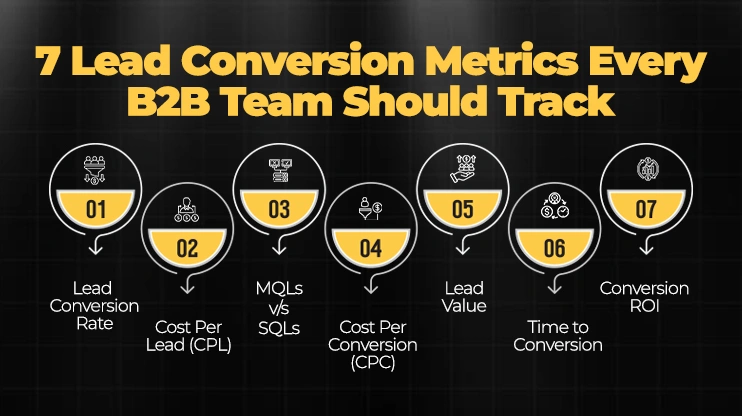
1. Lead Conversion Rate: Measuring Momentum (Foundation Metrics)
Lead conversion rate defines you by how many leads moved from captured to qualified leads in a defined step. The percentage tracking of such leads that moved to the next stage, depending on your funnel, that mean:
- Visitor to form fill
- Lead to MQL
- MQL to SQL
- SQL to Opportunity
- Opportunity to Genuine Customer
Lead Conversion Formula:
Lead Conversion Rate= (Converted Leads ÷ Total Leads) × 100
By this formula you can spot easily whether your funnel is improving or not, which results in helping by revealing your messaging, targeting, and engagement strategy are aligned with buyer intent.
A strong lead conversion rate is tracked by sources like:
- Relevant audience targeting
- Clear value propositions
- Effective conversion optimization across touchpoints
By this if your conversion rate improves by 10% your entire pipeline can become more efficient and this matters more to the decision-makers.
2. Cost Per Lead (CPL): Efficiency Without Context Is Risky
Cost per lead should be clear and should define the metric of “are we overspending”
Cost per lead indicated how much you’re spending or paying a amount to generate the lead across channel and how efficiently you’re generating leads. At Vereigen Media, we proceed with the Verified Content Engagement (content syndication) and VM Engage (display and programmatic ads) solution.
Formula:
CPL = Total Spend ÷ Total Leads
Why it matters:
- CPL affects the budget decisions
- Low CPL still produces the weak pipeline
- A higher CPL is worth when it produces SQLs and revenue faster.
Best way to use CPL is alongside with lead to sales conversion rate and lead quality indicator to determine which channels produce the revenue ready leads and where should one be scaled or left.
Smart CPL is optimized for cost per qualified lead, and the analysis includes: CPL by channel, persona and the industry.
3. MQLs vs. SQLs: The Alignment Metrics That Prevents Pipeline Waste
The ratio of Marketing Qualified Leads (MQLs) to Sales Qualified Leads (SQLs) is the best indicator of sales and marketing alignment. If your marketing team celebrates MQL volume leads and your sales team complaints about the lead quality, and not converting into SQLs it often means:
- Qualification criteria are too loose
- Engagement signals aren’t verified
- Sales doesn’t trust marketing sourced leads
Why it matters:
It helps you in revealing whether the leads are truly progressing or just being passed by.
What to track:
- MQL-SQL conversion rate
- SQL acceptance rate and rejected rate
- Time takes to convert in SQL from MQL
If you notice that the MQLs are high in number that the SQLs, your defination of qualified is too loose, and lacking trust.
4. Cost Per Conversion (CPC): Following the Money Past the Click
Cost per lead is way easy than cost per conversion.
Cost per conversion is what leadership role cares a lot about, by tracking how much you spend to drive a meaningful action, while generating meaningful outcome such as:
- Demo request
- Meetings booked
- Opportunity created
- SQL
Formula:
Cost Per Conversion = Total Spend ÷ Total Conversion
Why it matters:
It helps the teams to focus on pipeline impact, while aligning spend directly with the pipeline progression.
High performing teams use Cost Per Conversion to:
- Compare channel effectiveness
- Improve conversion across channels, LPs, and through follow-ups
- Justify budget allocation to leadership roles and decision-makers.
This is where real optimization gets started for measurable impact.
5. Lead Value: Assigning Revenue Potential Early
Lead value helps you to estimate the revenue potential of your leads before the deal closes. This helps you by telling what leads are worth of.
Calculate the lead value based on firmographics and historical performance by: Lead Value = (Total Revenue / Number of Leads) x Percentage Profit
Why this matters:
It helps marketing and sales team invest in what matters the most, generating the revenue for measurable outcome.
Why teams miss the mark: They treat every lead equally
Instead of treating every lead equally, you should prioritize:
- Accounts with higher lifetime value
- Leads that are more likely to convert into opportunities
When paired with the lead generation metrics, lead value help teams to focus on the key factors that matters.
Quick Read: Effective Lead Management to Maximize Your Lead Conversion Rate
6. Time to Conversion: Speed Signals Serious Intent
Time to conversion measures the time taken to hit a milestone, while moving from initial engagement to a qualified sales interaction.
- Lead to SQL
- SQL to Opportunity
- Opportunity to Closed-Won
Why it matters:
Speed impacts serious pipeline forecasting, increasing team capacity, and revenue predictability.
The particular metric helps you to answer:
- Are buyers stalling because they are not confident?
- Are we providing the personalized content that nurtures the ideal customers effectively?
What strong B2B organizational teams do:
- Reduce time to conversion to improve pipeline velocity
- Use intent-based touches apart from generic sequences
7. Conversion ROI: Proving Impact to Leadership
Conversion ROI is the only metrics that your CFO actually trust.
This metrics help you to connect marketing performance with revenue.
This trusted metric answers the question executives care about:
What we get back from the investment and is this pipeline profitable?
When teams start to convert ROI, they stop optimizing for: clicks, impressions, and surface level engagement.
And they start optimizing for: qualified pipeline growth and customer acquisition efficiency.
This is the difference where conversion optimization takes place, for marketing activity and revenue impact.
Supporting Metrics That Strengthen the Full Picture
While these seven metrics form the foundation, mature B2B teams also monitor:
- Opportunity win rates
- Sales cycle length
- Customer acquisition cost (CAC)
Together, they help contextualize lead conversion metrics within the full revenue engine.
How Vereigen Media Helps Teams Improve Lead Conversion
Many conversion issues don’t stem from effort, they stem from unverified engagement and misaligned data.
Vereigen Media helps B2B organizations improve lead conversion by focusing on:
- First-party, privacy-compliant data
- Human-verified content engagement through content syndication
- High-intent reach via VM Engage (display and programmatic ads)
- Accurate qualification aligned to sales expectations
The result is fewer wasted conversations, stronger lead to sale conversion rates, and a pipeline built on trust, not assumptions.
Right Metrics Convert Clarity Into Revenue Confidence
Lead conversion metrics are not about reporting, they’re about decision-making.
When you track the right metrics, you stop guessing. You see where buyers engage, where they hesitate, and where revenue momentum accelerates. More importantly, your team gets back something that every decision maker wants: confidence in the pipeline.
B2B leaders who had master in optimizing conversion doesn’t chase leads for volume. They build system on lead conversion, that help you convert the right one, consistently.
Ready to turn your lead conversion metrics into measurable revenue growth?
Book your free strategy session with Vereigen Media today and start building your pipeline aligned to verified engagement and real results.
Leads. Done Right.
FAQ’s on Lead Conversion Metrics Every B2B Team Should Be Tracking
The most important lead conversion metrics in B2B include lead conversion rate, MQL to SQL conversion, SQL to opportunity conversion rate, lead response time, lead value, and conversion ROI. These show the transparency of the funnel and revenue outcomes.
Lead conversion metrics help improve sales alignment by creating shared visibility into lead quality, intent, and readiness, reducing friction between marketing and sales teams.
Reduce MQL-to-SQL drop-off by aligning your definitions, improving lead scoring, focusing on higher-intent content, tightening targeting, and improving speed-to-lead follow-up processes.
Vereigen Media, a U.S.-based demand generation company help you improve lead conversion performance by delivering human verified, privacy-compliant leads reaching right buyers, and creating more measurable conversion outcomes through Verified Content Engagement (content syndication) and VM Engage (programmatic and display ads).
Written By –
